

Why Your Google Rankings Dropped After the Latest Update and How an SEO Agency Can Fix It
A sudden drop in organic search rankings following a Google update can feel like a sudden setback for any business. One day your primary search listings are driving qualified leads, and the next, your core pages seem to have vanished from key search results. Unraveling why these algorithmic shifts occur requires a structured diagnostic approach rather than immediate panic or impulsive fixes.
Modern search engines regularly refine their evaluations of web page quality, site authority, and user intent alignment. When a core update or spam refresh rolls out, it re-evaluates web properties against elevated standards. Partnering with professional seo agency recovery services allows businesses to isolate the true root cause of traffic loss, repair technical and content vulnerabilities, and establish a clear path toward sustainable ranking recovery.
Direct Recovery Answer: Google ranking drops after an update typically occur due to re-evaluated content helpfulness, technical performance bottlenecks, unaligned search intent, or low link quality. An SEO agency fixes this by conducting a root-cause forensic audit, removing toxic technical issues, enhancing content quality to meet modern E-E-A-T standards, and executing a structured algorithmic recovery plan tailored to Google’s updated criteria.
Table of Contents
- Understanding Why Google Updates Trigger Sudden Ranking Drops
- Common Technical and Content Vulnerabilities Exposed by Core Updates
- Diagnostic Steps: How to Assess Search Traffic Loss Correctly
- How SEO Agency Recovery Services Fix Algorithmic Drops
- Strategic Steps for Restoring Organic Search Visibility
- Comparative Analysis of Post-Update Drop Causes
- What to Expect During the SEO Recovery Timeline
Understanding Why Google Updates Trigger Sudden Ranking Drops
Google continuously updates its ranking systems to ensure search users receive accurate, relevant, and trustworthy information. Broad core updates do not target specific websites with manual penalties; instead, they re-calibrate how automated systems evaluate overall web page quality across the internet. When a core update occurs, pages that previously ranked high may be displaced by pages that offer superior user experience, greater depth, or clearer subject-matter expertise.
Understanding this distinction is critical for business owners. A drop during an algorithmic update does not necessarily mean your website committed a policy violation. Rather, it suggests that search systems now favor competitors whose content better satisfies current search intent, demonstrates higher Experience, Expertise, Authoritativeness, and Trustworthiness (E-E-A-T), or offers a seamless technical environment.
Common Technical and Content Vulnerabilities Exposed by Core Updates
Major search engine updates frequently act as stress tests for digital properties. Weaknesses that may have gone unnoticed during stable periods suddenly turn into significant ranking liabilities. Identifying these vulnerabilities is the first step toward reclaiming lost search performance.
- Scaled or Low-Value Content: Pages created solely to target keywords without offering practical insights, unique expertise, or original commentary are frequently demoted by helpful content systems.
- Misaligned Search Intent: Pages that fail to address the underlying motivation of a search query can lose ground when Google refines its understanding of user behavior.
- Technical and Performance Friction: Slow page loading speeds, erratic layout shifts, poor mobile responsiveness, or broken crawl directives negatively impact overall site performance evaluations.
- Weak Trust Signals (E-E-A-T): A lack of verified author credentials, missing commercial policies, unverified medical or financial statements, or unclear brand identity can degrade site trust.
- Unnatural Backlink Patterns: Automated updates targeting spam frequently neutralize low-quality or unnatural incoming links, causing dependent pages to drop in position.
Diagnostic Steps: How to Assess Search Traffic Loss Correctly
Before making changes to your website, it is essential to conduct a careful diagnosis. Making hasty alterations to code or deleting large amounts of content without analysis can exacerbate ranking loss and complicate future recovery efforts.
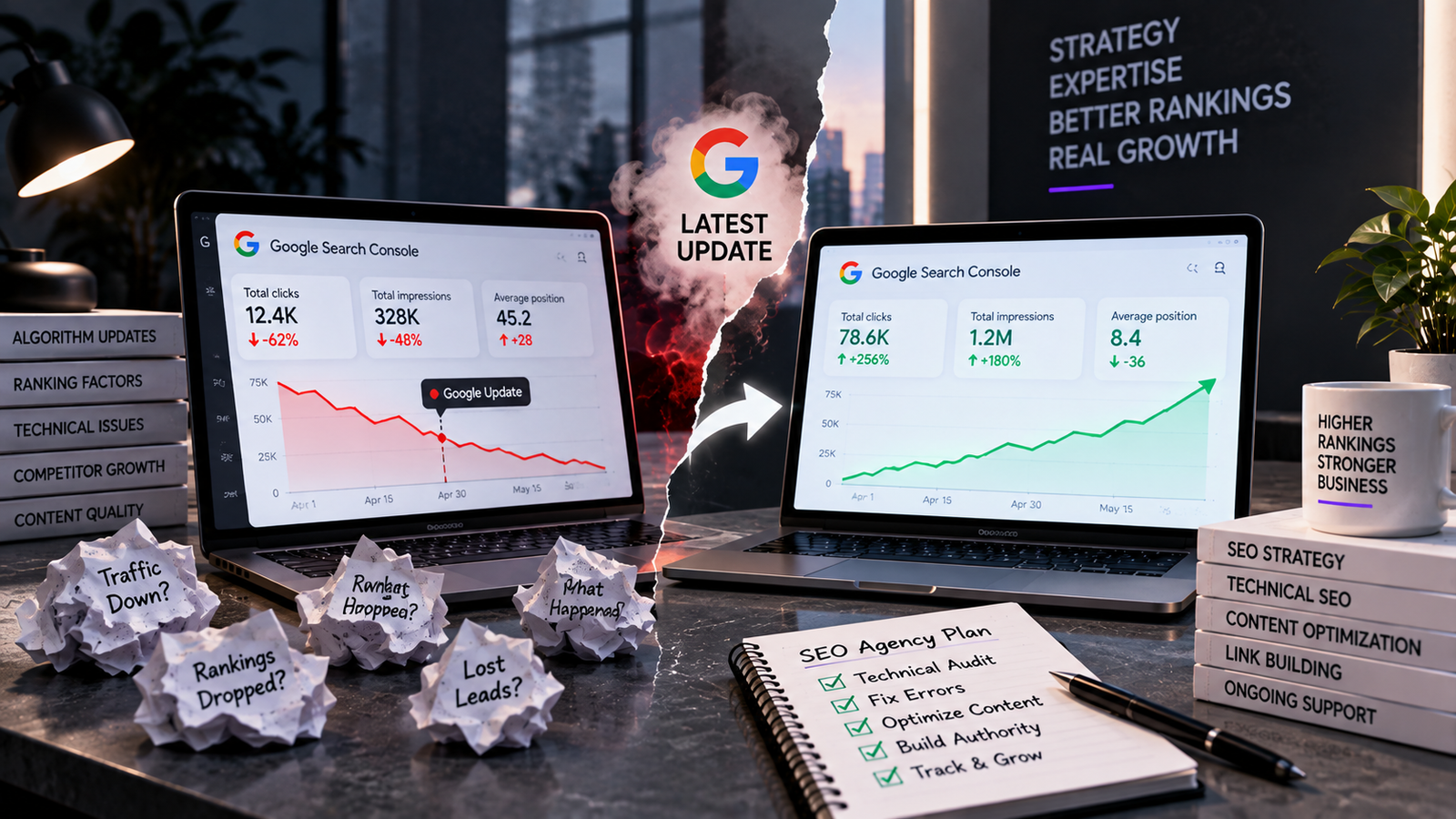
Proper diagnosis begins by isolating performance metrics in analytics tools. Compare search traffic before, during, and after the update rollout window. Determine whether the decline is isolated to specific URL subfolders, product categories, or device types, or if it represents a site-wide visibility shift. It is equally important to cross-reference traffic drops with Google Search Console reports to confirm whether the issue stems from an algorithmic recalibration or an explicit manual action.
How SEO Agency Recovery Services Fix Algorithmic Drops
Resolving a complex ranking drop requires specialized technical knowledge, analytical tools, and strategic execution. Standard SEO routines focused strictly on publishing new content are rarely sufficient to resolve systemic algorithmic demotions. Specialized seo agency recovery services deploy multi-layered remediation strategies designed to re-align web properties with Google’s quality criteria.
Businesses seeking to rebuild search authority must address structural site health, content utility, and technical accessibility simultaneously. Digifier Web Technologies LLP helps organizations diagnose complex search drops through forensic technical audits, targeted content restructuring, and strategic user-experience enhancements. If a site’s underlying framework presents severe technical debt or outdated responsive design, integrating specialized website rebuilding services may be necessary to construct a solid foundation for organic growth.
Strategic Steps for Restoring Organic Search Visibility
A structured recovery roadmap ensures that every critical site component is audited and restored systematically. Experienced specialists follow a methodical process to resolve underlying penalties or algorithmic downgrades:
- Forensic Technical Audit: Scan site architecture for crawl errors, canonical mismatches, duplicate content pathways, indexation bloat, and core web vitals issues that hinder search crawlers.
- Content Pruning and Enrichment: Identify thin, outdated, or unhelpful pages. Consolidate overlapping assets, rewrite low-quality passages, and remove content that fails to deliver genuine value to readers.
- Search Intent Alignment: Restructure existing pages to directly answer the specific questions and user intents associated with targeted keywords.
- E-E-A-T Framework Reinforcement: Build clear trust signals across the website, including explicit author profiles, detailed business verification disclosures, verifiable references, and clear publication policies.
- Link Profile Remediation: Evaluate backlink profiles to disavow spammy, low-quality, or manipulate link connections while strengthening internal linking pathways.
What to Expect During the SEO Recovery Timeline
Recovering from a major Google update is a structured process that requires patience and persistent execution. Unlike minor page optimizations, broad algorithmic re-evaluations typically reflect changes in how search engines view your entire digital domain.
Once remediation measures are implemented—such as content revisions, technical bug fixes, and structural updates—Google must re-crawl and re-index the modified URLs. For significant site-wide changes, measurable rank stabilization often aligns with subsequent core algorithm refreshes. Relying on professional agency guidance helps maintain strategic focus during this period, preventing reactive mistakes and establishing long-term search resilience.
Conclusion
Experiencing a ranking drop after a Google update is a clear signal that your digital assets require technical and content optimization. Trying quick fixes or ignoring underlying quality issues will rarely lead to index recovery.
By systematically auditing technical performance, refining search intent alignment, and upgrading site quality, businesses can regain competitive positions in organic search. Partnering with specialized seo agency recovery services ensures your business builds a durable, update-resistant web presence that delivers consistent organic results over time.