

Why Your Amazon and Marketplace Listings Get Impressions But Zero Buy Box Conversions
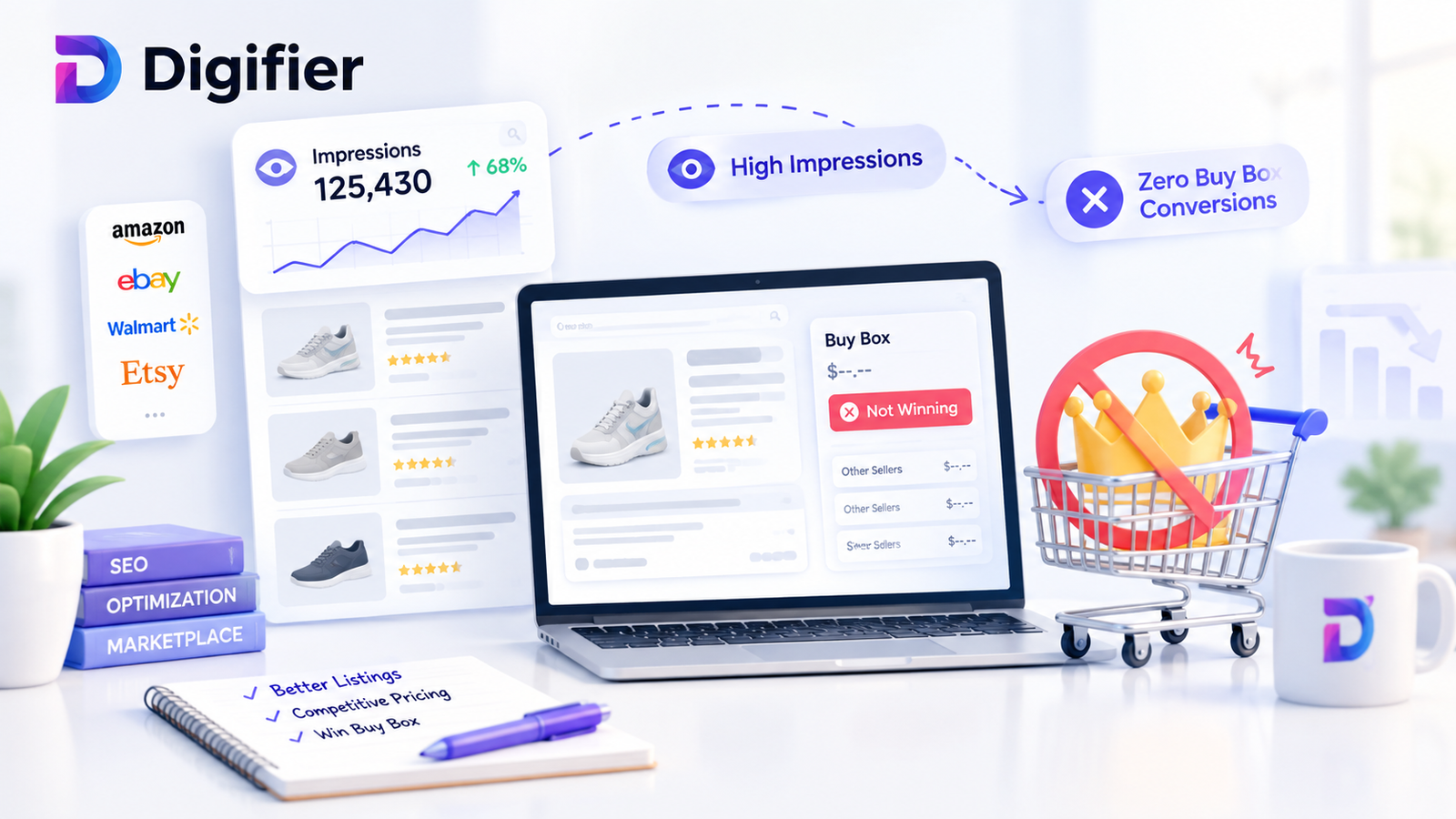
High listing impressions demonstrate that buyers are finding your product detail pages through search terms, category navigation, or paid marketplace advertising. However, accumulating thousands of views without securing sales usually points to a breakdown at the offer level. When an item consistently fails to capture or maintain Buy Box conversions, potential buyers leave the listing without taking action or choose competing sellers who present clearer purchasing advantages.
Resolving this conversion gap requires evaluating the mechanics behind marketplace algorithms. Factors such as landed pricing models, seller performance standards, inventory availability, and customer trust signals dictate whether your product earns the Featured Offer status. Partnering with a specialized marketplace listing optimization agency helps brands systematically identify hidden listing friction, protect seller margins, and restore transactional velocity across enterprise seller accounts.
Direct Answer: Marketplace listings generate high impressions but zero Buy Box conversions when the listing lacks Featured Offer eligibility, presents uncompetitive landed pricing, relies on slower fulfillment methods, or suffers from seller performance metric penalties. Even when a listing secures the Buy Box, conversions fail if product detail images, bullet points, customer reviews, or shipping lead times fail to convince shoppers to complete their purchase.
Table of Contents
- Understanding the Gap Between Marketplace Impressions and Conversions
- Core Reasons Your Listing Earns Views But Lost the Featured Offer
- How Detail Page Friction Destroys Conversions When You Own the Buy Box
- Systematic Steps to Recover Buy Box Share and Drive Sales
- Marketplace Conversion Friction vs Optimization Framework
- Frequently Asked Questions
- Conclusion
Understanding the Gap Between Marketplace Impressions and Conversions
In digital commerce, impressions and conversions measure fundamentally different stages of the customer journey. An impression is registered whenever a buyer views your product card in search results, browsing feeds, or sponsored campaign placements. High impression volume confirms that your indexing, target keywords, and listing taxonomy successfully align with buyer search queries.
A conversion, conversely, requires a buyer to evaluate your specific offer and select the primary purchase option. On major channels like Amazon and Walmart, the majority of total sales flow directly through the Buy Box—the prominent call-to-action block containing the Add to Cart and Buy Now buttons. When your detail page generates interest but fails to capture orders, the breakdown stems either from losing Buy Box placement to another seller or presenting an offer that discourages purchase completion.
Core Reasons Your Listing Earns Views But Lost the Featured Offer
Marketplace algorithms continually evaluate seller offers to determine which merchant best serves the end customer. If your account falls short on specific operational thresholds, the platform suppresses your offer or assigns the Buy Box to a competitor, leaving your listing with passive views but zero sales.
1. Uncompetitive Total Landed Price
Marketplace algorithms do not evaluate product price in isolation; they analyze the total landed cost, which combines item cost, shipping fees, and applicable taxes. If competing sellers or off-platform retail channels offer the exact item at a lower landed price, automated systems may suppress the Buy Box entirely, replacing it with a See All Buying Options link that drastically reduces purchase conversion rates.
2. Sub-Optimal Fulfillment Method and Speed
Fulfillment speed directly influences Featured Offer placement. Listings backed by program fulfillment such as Fulfillment by Amazon (FBA) or Walmart Fulfillment Services (WFS) inherently secure higher Buy Box priority over Merchant Fulfilled (FBM) listings. Slower handling times or elevated shipping costs diminish buyer trust, leading shoppers to select faster alternative options.
3. Declining Account Health and Performance Metrics
Automated marketplace algorithms actively protect customer satisfaction by penalizing accounts with poor operational metrics. Elevated Order Defect Rates (ODR), late shipment rates, pre-fulfillment cancellation rates, or unaddressed customer messages immediately diminish your Buy Box share, even if your selling price remains lower than competitors.
How Detail Page Friction Destroys Conversions When You Own the Buy Box
Securing the Featured Offer is only half the battle. If your seller account active position holds the Buy Box but fails to convert incoming shoppers, the underlying issue resides within the detail page content, visual hierarchy, and value communication.
- Inadequate Main Images: Low-resolution main images or ambiguous product presentation lower immediate buyer interest, prompting shoppers to return to search results.
- Missing A+ or Enhanced Content: Text-heavy detail pages without structured comparison tables, feature callouts, or branded visual assets struggle to communicate product value against established competitors.
- Unaddressed Customer Reviews: Unanswered negative feedback or unmanaged product rating declines create doubt at the moment of decision, counteracting paid advertising impressions.
- Unclear Product Specifications: Missing sizing charts, ambiguous material details, or incomplete feature bullets confuse consumers, forcing them to look for clearer alternatives.
Systematic Steps to Recover Buy Box Share and Drive Sales
Converting impressions into profitable orders requires a structured remediation plan across technical account metrics, catalog management, and conversion asset optimization.
- Audit Account Health and Eligibility: Verify that your seller central dashboard displays zero active policy violations, unhandled customer claims, or metric breaches that suppress Buy Box availability.
- Implement Automated Dynamic Pricing: Utilize rule-based or algorithmic repricing tools to maintain competitive landed pricing relative to competing offers without eroding bottom-line profit margins.
- Optimize Catalog Content Assets: Refine gallery images, infographic displays, clear product bullets, and enhanced brand content to answer consumer questions directly on the page.
- Align Cross-Channel Infrastructure: Businesses expanding beyond marketplaces into independent storefronts often benefit from integrated e-commerce solutions to harmonize inventory levels, pricing strategies, and order processing workflows.
- Leverage Professional Account Management: Working with Digifier Web Technologies LLP allows brands to overcome complex catalog suppression, eliminate conversion bottlenecks, and maintain long-term competitive positioning.
Frequently Asked Questions
Why does my listing have no Buy Box even though I am the brand owner?
Brand ownership does not automatically guarantee Buy Box allocation. If your price exceeds competitive retail benchmarks, if your seller health metrics drop below platform standards, or if fulfillment lead times are deemed excessively long, algorithms may suppress the Buy Box until offer parameters improve.
How long does it take to recover Buy Box eligibility after fixing pricing?
Price-related Buy Box recovery can occur within hours once automated indexing systems detect competitive landed costs. However, operational metric improvements or listing policy resolutions may require several days to recalculate across marketplace seller systems.
Conclusion
High listing impressions confirm that your organic search optimization and marketing campaigns are attracting customer interest. However, converting that visibility into reliable order volume requires winning the Buy Box and eliminating conversion barriers on product detail pages. By maintaining competitive landed pricing, optimizing operational fulfillment, and presenting clear product content assets, marketplace brands can effectively capture market share and eliminate stalled conversion performance. Professional audit services from a knowledgeable marketplace listing optimization agency ensure your catalog remains resilient against competitive threats and algorithmic shifts.