

Why Marketplace Listings Get Views But No Buy Box Conversions
Sellers on retail platforms often encounter a frustrating scenario: traffic reports show strong impressions and regular page visits, yet transactions fail to materialize. In competitive marketplaces, attention does not automatically translate into revenue. Achieving true amazon listing optimization for higher sales requires examining both retail readiness and conversion mechanics, rather than simply driving top-of-funnel traffic.
When a product listing receives views without sales, the problem almost always points to friction inside the decision journey. The product has enough discoverability to earn the click, but the listing either fails to secure the Featured Offer—commonly known as the Buy Box—or fails to justify the customer’s purchase decision once they land on the detail page.
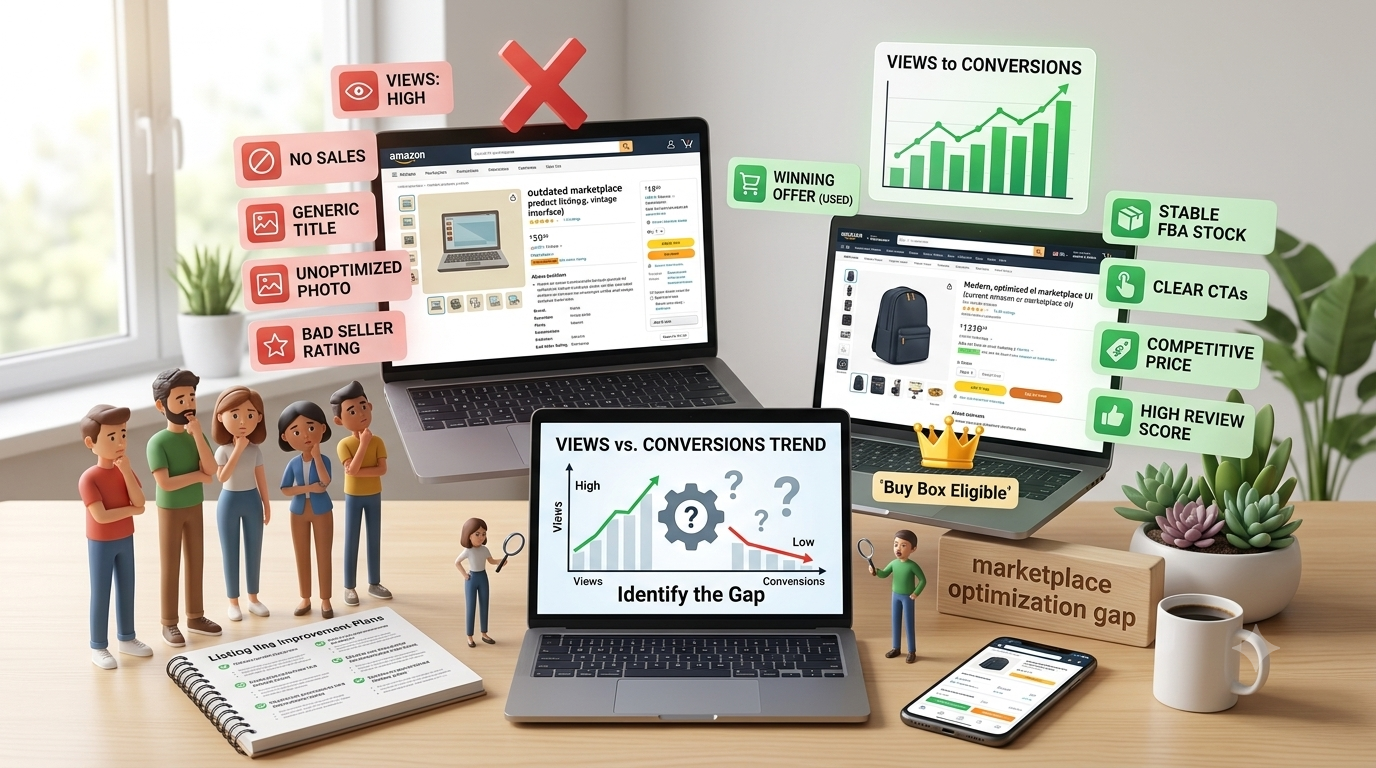
Marketplace listings accumulate views without conversions primarily because the seller does not consistently own the Buy Box, offers slower delivery than competitors, maintains non-competitive landed pricing, or presents weak on-page content that creates buyer hesitation. Traffic confirms that product discovery exists; absent sales indicate uncompetitive fulfillment metrics or unresolved consumer doubt at the point of decision.
Table of Contents
- The Disconnect Between Marketplace Impressions and Conversions
- Buy Box Suppression and Loss of the Featured Offer
- Fulfillment Speed and Its Impact on the Purchasing Decision
- Listing Quality Issues That Drive Away Ready Buyers
- Pricing Discrepancies and Competitor Price Matching
- Structured Framework to Diagnose Marketplace Conversion Drops
- Strategic Steps to Restore Buy Box Competitiveness
The Disconnect Between Marketplace Impressions and Conversions
High impressions alongside zero or depressed sales indicate that your search indexing works, but your conversion ecosystem does not. Marketplace search engines reward relevance by showing your product in response to buyer search terms. However, once a shopper clicks through, standard retail evaluation criteria take priority over keyword placement.
A customer visit is merely an opportunity to make a pitch. If the listing generates thousands of glance views while orders remain flat, the search intent of the shopper is being broken somewhere on the detail page. Sellers frequently mistake search advertising and indexing as total solutions, overlooking the operational elements required to turn a browser into a confirmed buyer.
Buy Box Suppression and Loss of the Featured Offer
The most common technical cause for a sudden divergence between views and sales is losing the Featured Offer, or suffering full Buy Box suppression. When the Buy Box is absent, the prominent “Add to Cart” and “Buy Now” buttons vanish from the listing page. Shoppers are instead forced to click “See All Buying Options,” which adds considerable friction and reduces buyer trust.
Buy Box suppression frequently occurs when an algorithm detects that the product is offered at a lower price on another retail website or external channel. It can also occur when seller account health metrics fall below acceptable thresholds, or when sudden price increases trigger price-gouging safeguards.
- Account Health Fluctuations: Spikes in late shipment rates, order defect rates, or unaddressed customer messages can immediately revoke Featured Offer eligibility.
- Off-Platform Price Scrapes: Automated marketplace crawlers continuously compare prices across competing platforms, penalizing listings that price higher than alternate channels.
- Third-Party Resellers: Unauthorized or third-party merchants matching or undercutting your price by nominal amounts can capture the Buy Box entirely, receiving the actual sale while your brand pays for ad clicks.
Fulfillment Speed and Its Impact on the Purchasing Decision
Delivery speed is a primary ranking and conversion pillar across modern e-commerce channels. Modern marketplace shoppers prioritize rapid delivery, often filtering search results exclusively for Prime or equivalent expedited fulfillment options. If your listing displays an extended shipping timeline, conversion likelihood drops dramatically regardless of listing quality.
Sellers utilizing merchant-fulfilled channels often display delivery windows spanning several business days. When placed beside competing listings that guarantee one-day or two-day delivery through regional fulfillment networks, shoppers will consistently bypass the slower offer. Even if your price is competitive, consumers often equate longer shipping windows with inventory risk or poor logistical support.
Listing Quality Issues That Drive Away Ready Buyers
While technical Buy Box metrics dictate who gets the sale, on-page content dictates whether the shopper buys at all. Effective amazon listing optimization for higher sales requires bridging the gap between algorithmic relevance and human psychology. If product imagery, descriptions, or review profiles leave unanswered questions, visitors leave the page without checking out.
Professional execution requires thorough catalogue management and strategic clarity. For brands managing extensive multi-channel inventories, partnering with specialists in marketplace services ensures that detail pages maintain accurate asset synchronization, consistent pricing rules, and compliance with platform-specific display standards.
Inadequate Visual Representation
Low-resolution images, lack of lifestyle context, and absence of infographic dimensions force shoppers to guess how the product functions in real life. When buyers cannot clearly inspect materials, scale, or operational details, risk aversion takes over, prompting them to navigate back to search results to find a clearer listing.
Unaddressed Negative Customer Feedback
A product may attract views because of an appealing title, but a prominent critical review highlighting a recurring defect will halt conversions instantly. If your listing fails to counter recurring objections through updated product copy, detailed bullet points, or revised imagery, shoppers will treat recent negative feedback as conclusive evidence to avoid purchase.
Pricing Discrepancies and Competitor Price Matching
Marketplace shoppers are exceptionally price-sensitive and frequently compare several open tabs before finalizing an order. If your product is priced substantially higher than direct equivalents without clear differentiation in materials, warranties, or bundled accessories, listing views will simply serve to validate a competitor’s superior value proposition.
Furthermore, coupon tags, automated discounts, and strike-through pricing catch buyer attention in search results. When a buyer visits your listing and finds a flat, undiscounted price point while similar offerings carry promotional flags, the perceived transaction value diminishes immediately.
Structured Framework to Diagnose Marketplace Conversion Drops
Identifying why your listings fail to generate transactions requires a systematic review of platform metrics. Instead of guessing, sellers should isolate performance variables sequentially, beginning with technical access to the sale and ending with consumer-facing presentation factors.
Strategic Steps to Restore Buy Box Competitiveness
Fixing a non-converting product requires deliberate operational changes. Driving more paid traffic into a leaky detail page simply accelerates ad spend without growing store revenue. Instead, implement a methodical approach to establish retail readiness across operations and listing creative.
- Establish Automated Repricing Rules: Protect Buy Box share by implementing floor-guarded dynamic repricing that instantly responds to unauthorized sellers and fluctuating competitor pricing.
- Optimize Fulfillment Channels: Maintain sufficient inventory in centralized fulfillment centers to ensure Prime eligibility and provide short delivery timelines across key sales territories.
- Resolve Information Ambiguity: Review customer questions and negative ratings to rewrite product bullet points, updating technical specifications to eliminate pre-purchase doubts.
- Monitor Cross-Channel Parity: Ensure your direct-to-consumer store and external retail channels do not undercut your marketplace listings, preserving algorithmic Buy Box eligibility.
Navigating marketplace compliance, operational thresholds, and dynamic pricing demands disciplined execution across multiple touchpoints. Digifier Web Technologies LLP assists businesses in auditing operational performance, establishing retail-ready catalog structures, and eliminating friction points that prevent page views from turning into transactions.
Conclusion
High page impressions paired with stagnant order numbers are a clear diagnostic signal: traffic generation has succeeded, but operational and conversion mechanics have broken down. Uncovering whether the failure stems from suppressed Buy Box access, uncompetitive fulfillment speeds, or incomplete detail page assets is the essential first step toward recovery.
Sustainable growth in modern multi-seller ecosystems requires treating product detail pages as end-to-end retail assets rather than simple keyword containers. By actively managing price parity, protecting Featured Offer eligibility, and maintaining robust on-page creative, sellers can execute comprehensive amazon listing optimization for higher sales that reliably turns incoming views into dependable revenue.
Relevant Hashtags
#AmazonBuyBox #AmazonListingOptimization #MarketplaceManagement #EcommerceConversions #AmazonSellerCentral