

Wasting Money on Ads That Don’t Convert? Why Your Digital Marketing Strategy Needs a Full-Funnel Revamp
Increasing customer acquisition costs and plateauing campaign performance are common challenges for growing businesses. Many brands pour substantial budget into search ads, paid social campaigns, and display network channels, only to see high click-through rates that yield negligible revenue. When paid traffic fails to generate qualified leads or direct sales, business leaders often assume their advertising channels are broken. In reality, the issue rarely lies within ad channels alone; it stems from treating paid advertising as an isolated tactic rather than part of an integrated, multi-stage customer journey. Partnering with a skilled performance digital marketing agency or restructuring your internal growth approach often reveals that conversion leakage happens long after the initial click.
To stop draining marketing budgets on cold traffic that bounces immediately, companies must step back and evaluate their complete digital ecosystem. A full-funnel revamp addresses every touchpoint a buyer experiences, from initial problem awareness through post-conversion retention. When messaging, landing page design, technical site performance, and sales nurture sequences operate in harmony, advertising spend transitions from an unpredictable cost center into a predictable engine for business scale.
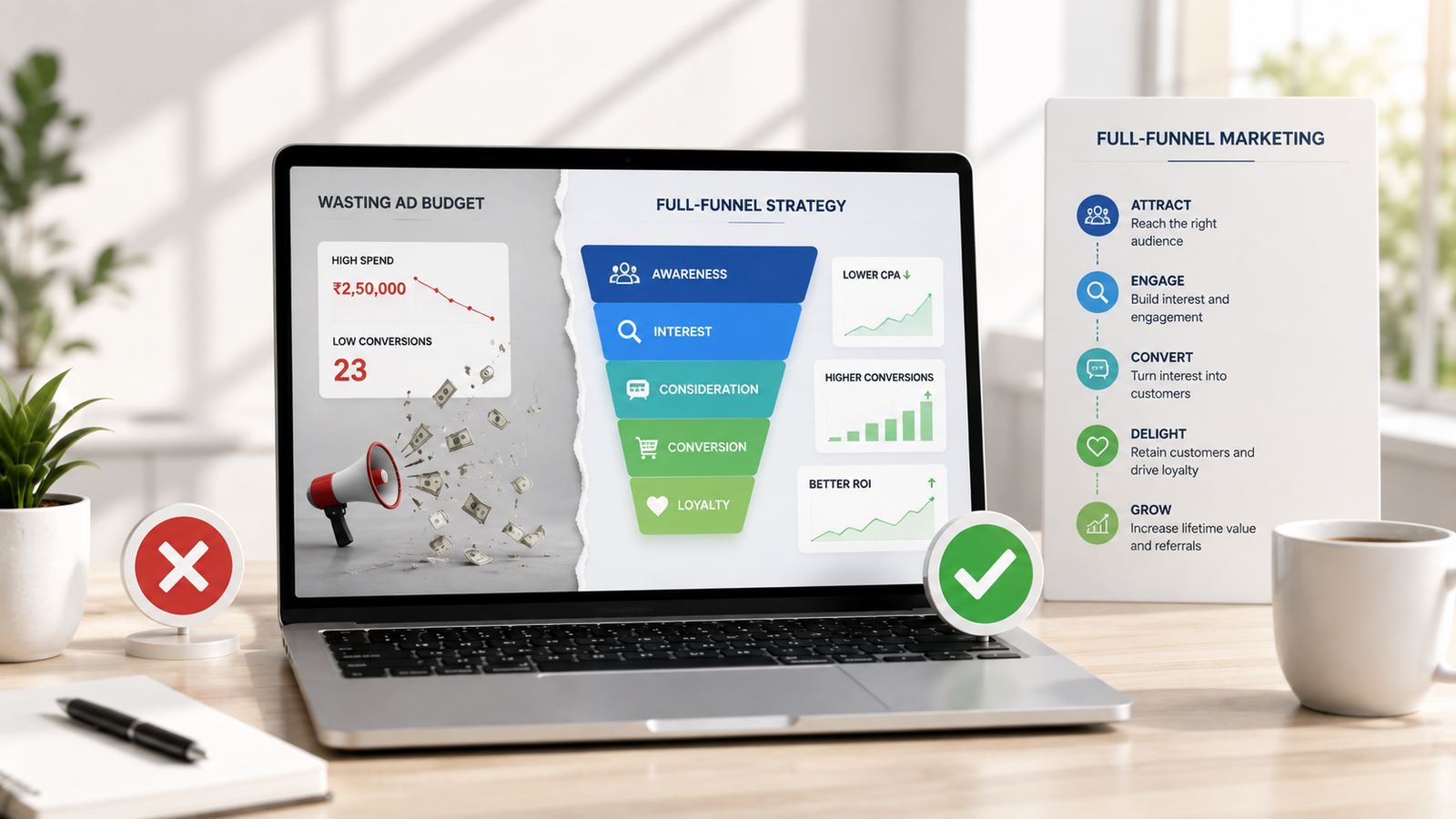
Direct Answer: Paid advertising campaigns fail to convert when marketers focus exclusively on top-of-funnel traffic while neglecting campaign messaging alignment, landing page design, site friction, and follow-up nurture paths. A full-funnel digital marketing revamp connects top-of-funnel awareness, middle-of-funnel consideration, and bottom-of-funnel conversion tactics into a cohesive strategy, ensuring that prospective buyers receive relevant messaging at every stage of their decision-making process.
Table of Contents
- Understanding the Mechanics of Full-Funnel Digital Marketing
- Primary Reasons Paid Ads Fail to Convert Traffic
- Core Stages of an Architecture-Driven Growth Funnel
- Single-Tactic Advertising vs. Full-Funnel Strategy Strategy Comparison
- How a Performance Digital Marketing Agency Optimizes Revenue Pathways
- Actionable Indicators Your Strategy Requires an Immediate Revamp
Understanding the Mechanics of Full-Funnel Digital Marketing
Traditional digital advertising often relies on a direct-response dynamic: an ad is served, a user clicks, and the business expects an immediate transaction or lead form submission. While this direct path works for simple products or highly motivated buyers, modern consumer behavior is far more nuanced. B2B buyers, high-value e-commerce shoppers, and service-seeking clients evaluate multiple touchpoints before making a commitment.
A full-funnel digital marketing strategy structures campaigns according to buyer readiness. Instead of forcing cold prospects directly toward high-friction conversion offers, a full-funnel approach introduces tailored content and engagement mechanics mapped across three core phases:
- Top of the Funnel (TOFU): Generates targeted awareness and educates potential customers about specific challenges or pain points.
- Middle of the Funnel (MOFU): Nurtures interested prospects by demonstrating authority, outlining specific solutions, and addressing common evaluation criteria.
- Bottom of the Funnel (BOFU): Captures high-intent prospects through direct offers, risk-reversing propositions, clear value proof, and streamlined conversion paths.
When organizations transition toward integrated performance-focused marketing programs, ad budgets are distributed strategically to support prospective customers throughout their entire decision lifecycle rather than relying entirely on immediate impulse action.
Primary Reasons Paid Ads Fail to Convert Traffic
If your paid ad campaigns are driving website traffic without generating meaningful pipeline or revenue, the problem stems from core operational disconnects between ad copy and website infrastructure. Identifying these disconnects is the first step toward correcting wasted advertising spend.
1. Message Mismatch Between Ads and Destination Pages
One of the most frequent causes of campaign failure is a disconnect between the ad creative and the destination page. When an ad promises a specific solution, competitive price point, or educational asset, but the landing page displays generic corporate messaging, users experience immediate cognitive friction and leave the site.
2. Technical Bottlenecks and Post-Click User Friction
Even highly targeted ad copy cannot compensate for a poor user experience. Slow page load times, cluttered layouts, confusing navigation, and complicated contact forms frustrate visitors. When campaign traffic arrives on an outdated or friction-heavy page, conversion rates plummet. Exploring targeted website rebuilding services helps eliminate technical lag, align layout architecture, and streamline lead submission workflows.
3. Demanding Immediate Commitment From Cold Audiences
Asking a first-time website visitor to instantly schedule a sales call or purchase a premium offering often creates resistance. Cold audiences need trust before making significant commitments. Expecting top-of-funnel ad traffic to convert at bottom-of-funnel rates leads to high bounce rates and inflated customer acquisition costs.
Core Stages of an Architecture-Driven Growth Funnel
Building a resilient digital strategy requires designing specific touchpoints for each step of the buyer’s journey. When these stages are connected seamlessly, user drop-off decreases and revenue predictability improves.
- Targeted Top-of-Funnel Acquisition: Deploy educational ad creative, video assets, and search campaigns targeted around broad search intent. The main objective at this phase is capturing attention, generating qualified traffic, and establishing initial brand presence.
- Middle-of-Funnel Nurturing Systems: Use remarketing channels, valuable downloadable resources, and tailored email sequences to keep engaged visitors connected. Highlight brand differentiation, case studies, product value, and practical applications to build authority.
- Bottom-of-Funnel Conversion Mechanics: Direct high-intent prospects toward dedicated, high-converting landing pages featuring strong trust signals, intuitive forms, transparent value propositions, and precise calls to action.
When businesses work alongside strategic implementation partners like Digifier Web Technologies LLP, the growth focus shifts from buying disconnected clicks to engineering an end-to-end operational funnel designed to capture and convert high-value demand.
How a Performance Digital Marketing Agency Drives Sustainable ROI
Selecting the right growth partner requires looking beyond simple ad management services. A specialized performance digital marketing agency focuses on overall revenue strategy rather than vanity metrics like impression counts or raw click volumes. When evaluating potential agency partners, look for teams that prioritize full-funnel optimization and data transparency.
Key operational capabilities to look for in a performance-focused agency partner include:
- Multi-Channel Attribution Setup: Implementing tracking systems that attribute conversions accurately across paid, organic, email, and referral touchpoints.
- Continuous Landing Page Optimization: Conducting systematic A/B testing on page headlines, form layouts, call-to-action buttons, and value propositions.
- Audience Retargeting Frameworks: Building segmented retargeting campaigns that address hesitation factors and keep prospective buyers engaged over time.
- Content Alignment Strategies: Ensuring search ads, social creative, and website content share a consistent value message.
Actionable Indicators Your Strategy Requires an Immediate Revamp
Recognizing the early warning signs of an underperforming marketing strategy prevents ongoing budget waste. If your business displays any of the following symptoms, it is time to audit your growth architecture:
- High Bounce Rates on Paid Landing Pages: Visitors leave within seconds of clicking your ad, indicating message mismatch or slow load speeds.
- Steep Drop-offs in Lead Forms or Checkout: High intent traffic initiates conversion steps but abandons due to form length, lack of trust signals, or technical glitches.
- Rising Customer Acquisition Costs (CAC): Paying increasingly more for fewer total conversions, forcing you to continuously increase media budgets just to maintain baseline results.
- Disconnected Retargeting Campaigns: Showing the exact same top-of-funnel ad to users who have already visited your pricing or product pages multiple times.
Conclusion
Continuing to spend money on advertising campaigns that fail to convert is an avoidable risk. When digital ads are executed in isolation, rising acquisition costs and diminishing returns are virtually inevitable. By revamping your strategy into a cohesive, full-funnel ecosystem, you ensure that every dollar spent on paid traffic works alongside robust landing pages, clear audience segmentation, and effective lead-nurturing workflows.
Whether you choose to overhaul your strategy internally or collaborate with an experienced performance digital marketing agency, aligning top-of-funnel acquisition with post-click conversion mechanics remains the single most reliable way to stop ad waste and build a sustainable engine for revenue growth.