

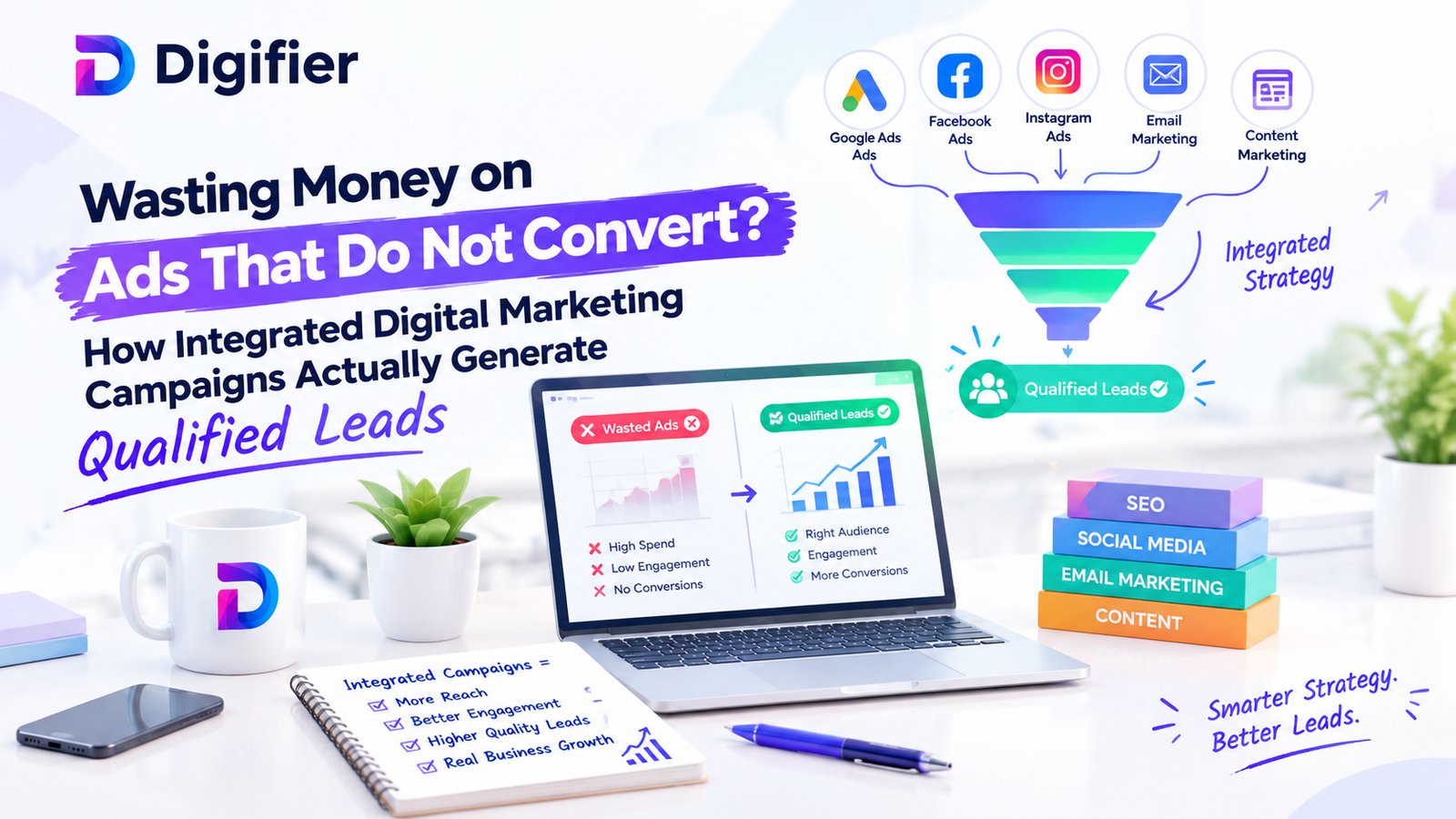
Wasting Money on Ads That Do Not Convert? How Integrated Digital Marketing Campaigns Actually Generate Qualified Leads
Running paid advertising without generating tangible business growth is a frustrating reality for many organizations. Marketing budgets are frequently allocated toward search ads, social media promotions, and display banners, only to result in high click counts and empty sales pipelines. When paid traffic fails to yield genuine inquiries, business leaders often question whether online advertising works at all. However, the root issue rarely lies in the advertising channels themselves, but rather in treating paid ads as isolated tactics rather than part of a cohesive ecosystem.
A truly effective lead generation digital marketing strategy requires alignment across messaging, user experience, content architecture, and technical tracking. When ad campaigns operate in a vacuum, prospects encounter disconnected brand messages, confusing landing pages, and weak value propositions. Transitioning from wasted ad spend to consistent customer acquisition requires an integrated campaign framework that engages qualified prospects at every stage of their decision-making journey.
Direct Answer: Integrated digital marketing campaigns generate qualified leads by synchronizing search intent, targeted advertising, dedicated landing page experiences, and multi-touch nurture workflows. Unlike isolated ads that rely solely on immediate clicks, integrated strategies align paid traffic with organic search, content authority, and retargeting systems to systematically guide prospects from awareness to conversion.
Table of Contents
- Why Isolated Paid Ads Frequently Fail to Convert
- Understanding the Integrated Lead Generation Digital Marketing Strategy
- Key Structural Pillars of an Integrated Digital Campaign
- Comparing Isolated Ads with Integrated Marketing Frameworks
- Connecting Organic Search and Paid Media for Maximum Impact
- Measuring Lead Quality Instead of Unproductive Clicks
- Steps to Transition Your Business Toward Integrated Lead Generation
Why Isolated Paid Ads Frequently Fail to Convert
Many organizations launch pay-per-click ad groups or social ad campaigns assuming that direct traffic will automatically produce sales calls or form submissions. In practice, isolated paid ads usually fail because modern buyers rarely purchase or inquire during their initial point of contact. High-intent decision-makers evaluate trust indicators, research alternatives, and look for educational context before submitting contact information.
When an ad directs a user to a generic homepage rather than a tailored destination, friction increases immediately. The visitor is left searching for information that matches the promise made in the advertisement. Common points of failure in standalone ad setups include:
- Message Mismatch: Ad headlines promise a specific solution, but the destination page provides broad, generic corporate descriptions.
- Lack of Middle-Funnel Nurturing: Organizations fail to engage visitors who are interested but not yet ready to purchase immediately.
- Inadequate User Experience: Slow page load speeds and poor mobile responsive design create immediate abandonment before content can be consumed.
- Fragmented Analytics: Conversion tracking is incomplete, making it difficult to understand which audience segments possess real commercial intent.
Understanding the Integrated Lead Generation Digital Marketing Strategy
An integrated lead generation digital marketing strategy connects every customer touchpoint into a single cohesive system. Instead of viewing search engine optimization, paid advertising, social engagement, and email communication as separate activities, integration treats them as interdependent components of one unified conversion pipeline.
When an integrated model is deployed, paid ads function as the initial catalyst to capture immediate active search intent or precise audience demographics. Simultaneously, educational content builds domain authority, strategic remarketing keeps your solutions top-of-mind, and clear conversion paths streamline user interaction. This multi-channel alignment ensures that whether a prospect discovers your enterprise through an ad, a search engine result, or an industry publication, the experience remains consistent and compelling.
Professional strategies designed by Digifier Web Technologies LLP focus on linking audience behavior, strategic funnel mapping, and performance analytics to ensure that marketing expenditures generate verified business inquiries rather than superficial engagement metrics.
Key Structural Pillars of an Integrated Digital Campaign
To transform unpredictable advertising expenses into a predictable acquisition framework, campaigns must be constructed around four foundational pillars. Omitting any single pillar weakens the entire acquisition structure and increases lead costs.
1. Intent-Based Audience Targeting
Generating qualified leads begins with identifying prospects actively seeking solutions. Paid search captures buyers at the exact moment of search intent, while paid social targeting isolates demographic and professional criteria. Aligning ad copy directly with specific commercial queries ensures traffic consists of decision-makers rather than casual browsers.
2. Dedicated High-Conversion Destinations
Sending paid traffic to general website pages dilutes user focus. High-performing campaigns direct prospects to dedicated, conversion-focused destinations. If an organization’s existing web presence suffers from slow load times or unclear navigation, modernizing through targeted website rebuilding services helps remove structural obstacles and improves overall conversion efficiency.
3. Multi-Touch Retargeting and Nurturing
Most high-value prospects require multiple interactions before scheduling a consultation or requesting a quote. Integrated campaigns use segmented retargeting across search and display channels alongside automated email sequences to deliver relevant case studies, product frameworks, and educational assets.
4. Closed-Loop Performance Measurement
Tracking must extend beyond simple click-through rates. Integrated strategies implement end-to-end event tracking to monitor how visitors navigate through forms, phone calls, and resource downloads. Connecting digital analytics with customer relationship platforms enables teams to evaluate campaigns based on pipeline value rather than cost per click.
Connecting Organic Search and Paid Media for Maximum Impact
Paid advertising and search engine optimization are often treated as competing strategies. In reality, they perform best when developed in tandem. Paid ad data provides rapid insights into high-converting search queries, valuable messaging variations, and intent-driven keywords. These insights can immediately inform organic content priorities.
Businesses looking to strengthen long-term organic authority alongside immediate paid customer acquisition can leverage structured professional SEO services to dominate search page real estate. When prospective buyers see an organization occupying both paid positions and organic search results for industry keywords, brand credibility increases, driving higher overall click-through rates and conversion confidence.
Measuring Lead Quality Instead of Unproductive Clicks
A major reason advertising spend feels wasteful is the focus on surface-level vanity metrics. High click counts and low costs per click mean very little if incoming leads fail to match your target customer profile. Evaluating campaign health requires evaluating lead quality through structured criteria.
To ensure campaigns attract genuinely qualified prospects, evaluation metrics must prioritize:
- Sales Qualification Rates: Percentage of incoming form inquiries that meet defined sales criteria.
- Cost Per Qualified Prospect: Total marketing expenditure divided strictly by validated commercial opportunities.
- Pipeline Contribution: Total estimated business value generated by digital inquiries over specific timeframes.
- Customer Acquisition Cost (CAC): Final cost involved in acquiring a paying client across all combined campaign channels.
Steps to Transition Your Business Toward Integrated Lead Generation
Shifting away from fragmented ad spends toward an integrated acquisition framework requires deliberate planning and systematic execution. Follow these actionable steps to realign your digital marketing efforts:
- Audit Existing Ad Channels: Review active campaigns to identify non-converting keywords, audience fatigue, and mismatched landing pages.
- Map User Conversion Paths: Define the precise journey prospects take from initial ad exposure to inquiry, ensuring clear educational content exists for every decision stage.
- Optimize Destination Pages: Ensure every active paid ad leads to a dedicated landing page designed specifically around the user’s search intent.
- Deploy Retargeting Infrastructure: Implement cross-channel tracking scripts to re-engage non-converting visitors with tailored messaging across display and search platforms.
- Align Marketing and Sales Feedback: Establish regular review cycles between marketing operations and sales representatives to continuously refine lead scoring based on real customer feedback.
Conclusion
Wasting budget on non-converting digital ads is rarely a sign that online marketing is ineffective. Instead, it indicates that prospective customers are being directed through disjointed acquisition paths. Isolated advertising tactics can drive superficial web traffic, but long-term business growth relies on a strategic lead generation digital marketing strategy that seamlessly connects paid ads, search engine visibility, content nurturing, and technical conversion optimization.
By mapping campaign efforts around genuine search intent, dedicated landing page experiences, and multi-touch lead nurturing, organizations can turn unpredictable marketing costs into a structured, highly scalable lead acquisition machine.