

Struggling With Manual Operations? How Custom Commercial Software and CRM Integration Scale Up Growing Enterprises
As an enterprise expands, operational complexity increases exponentially. Workflows that relied on spreadsheets, manual data entry, and fragmented communication tools during early growth rapidly become major structural bottlenecks. Enterprise leaders often discover that team members spend more time reconciling mismatched records and manually updating status reports than executing high-value business tasks. Continuing to operate with disjointed legacy systems severely limits operational velocity, increases error rates, and degrades customer satisfaction.
Overcoming these operational limits requires moving away from piecemeal applications toward unified digital infrastructure. Partnering with a specialized custom software development company allows organizations to replace repetitive administrative tasks with tailored workflow automation and deep customer relationship management (CRM) integration. By establishing a single source of truth across operations and sales, growing enterprises establish the technical foundation required to scale efficiently without expanding overhead costs.
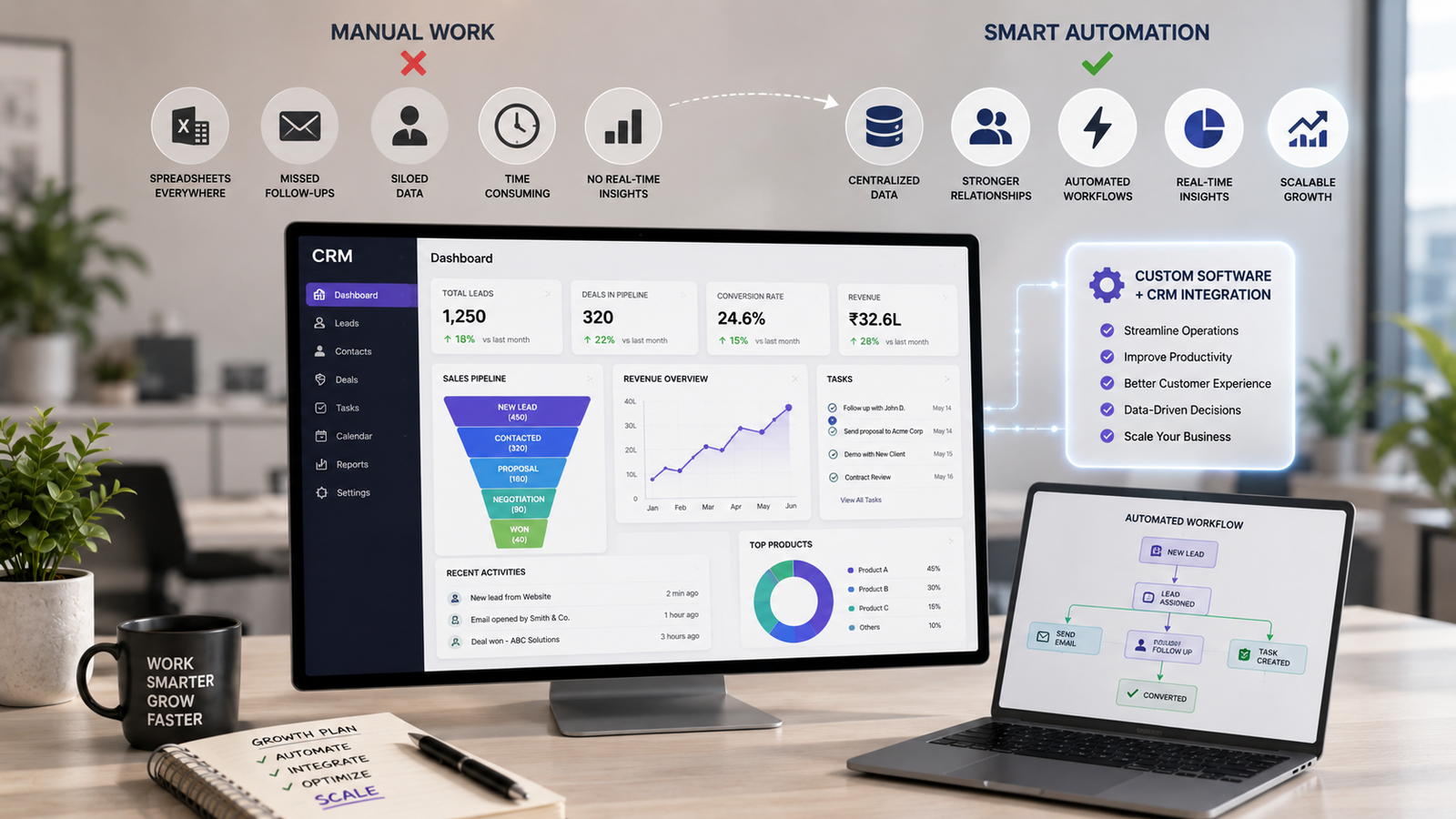
Custom commercial software and CRM integration resolve operational bottlenecks by centralizing enterprise data, automating repetitive tasks, and synchronizing customer information with core business workflows. Replacing manual processes with dedicated software platforms eliminates duplicate data entry, reduces operational errors, accelerates customer fulfillment, and provides real-time visibility across all business departments.
Table of Contents
- The Hidden Operational Bottlenecks of Manual Enterprise Processes
- Why Off-the-Shelf Applications Fail Complex Enterprise Workflows
- How Custom Commercial Software Eliminates Manual Friction
- The Strategic Role of Seamless CRM Integration in Operations
- Key Advantages of Working With a Custom Software Development Company
- Comparing Manual Workflows vs Custom Integrated Systems
- A Strategic Roadmap for Transitioning to Custom Operations
The Hidden Operational Bottlenecks of Manual Enterprise Processes
In early-stage businesses, manual workflows offer agility and low upfront setup costs. Standard spreadsheets, shared documents, and individual communication channels work adequately when handling modest transaction volumes. However, as business operations scale, these same manual processes turn into costly liabilities that restrict business efficiency.
Enterprise growth exposes several structural vulnerabilities inherent to manual operations:
- Data Fragmentation across Departments: When sales, operations, and finance teams maintain independent spreadsheets, company records become inconsistent, creating conflicting reporting and misplaced data.
- Elevated Human Error Rates: Manual data transcription, copy-pasting, and keying in operational details repeatedly lead to order mistakes, billing discrepancies, and fulfillment delays.
- Lack of Real-Time Operational Visibility: Leadership teams struggle to make informed strategic decisions when performance reports must be compiled manually over several days or weeks.
- Inefficient Resource Allocation: Skilled personnel waste productive hours on repetitive administrative entry instead of serving clients or building strategic initiatives.
Why Off-the-Shelf Applications Fail Complex Enterprise Workflows
When organizations realize that spreadsheets are no longer sufficient, many turn to pre-packaged commercial applications. While off-the-shelf software offers rapid deployment, it frequently forces growing enterprises to adapt their unique, successful processes to fit restrictive pre-built software templates.
Off-the-shelf tools often create new operational challenges for expanding companies. Subscription-based platforms frequently charge escalating per-user fees that make scaling cost-prohibitive. Furthermore, generic applications rarely integrate seamlessly with proprietary internal systems or specialized industry databases, resulting in disconnected software silos that still require manual workarounds to connect information.
When an enterprise relies on dozens of separate pre-packaged platforms, employees spend excessive time switching between incompatible dashboards. This lack of architectural cohesion creates operational friction, reduces data security, and limits an enterprise’s ability to innovate ahead of market competitors.
How Custom Commercial Software Eliminates Manual Friction
Custom enterprise application design addresses operational friction at its root source. Rather than adjusting standard operational models to software constraints, tailored systems are constructed to align precisely with existing business logic, regulatory compliance needs, and customer delivery models.
By deploying tailored commercial software solutions, growing businesses build centralized platforms that unify operational tasks into coherent, automated workflows. Custom applications streamline operations through targeted feature development:
- Automated Process Execution: Trigger-based rules automatically assign tasks, generate documentation, update inventory, and notify managers when specific milestones are reached.
- Centralized Data Architecture: Operational databases gather incoming inputs into a secure engine, ensuring that all teams operate from real-time enterprise metrics.
- Scalable Cloud Infrastructure: Custom software platforms scale computing capacity dynamically as order volumes expand, keeping performance consistent during demand spikes.
- Role-Based Access Control: Enterprise-grade security protocols ensure employees access only the information necessary for their roles, protecting proprietary assets and personal user records.
The Strategic Role of Seamless CRM Integration in Operations
Customer Relationship Management systems store valuable interaction histories, sales opportunities, and client preference profiles. However, when a CRM operates as an isolated database detached from internal operations, customer-facing teams remain out of sync with fulfillment pipelines, inventory availability, and financial status.
Deep CRM integration bridges the gap between client acquisition and back-office delivery. When a client closes a contract, integrated systems automatically pass structured transactional records directly into core operational platforms without requiring manual entry from sales representatives.
This unified communication layer ensures that account managers, support specialists, and production teams gain immediate context on client status. Automated synchronization reduces fulfillment cycles, prevents billing errors, and improves client retention by providing consistently reliable operational updates.
Key Advantages of Working With a Custom Software Development Company
Building resilient enterprise software requires technical expertise, operational foresight, and rigorous quality assurance. Engaging an experienced custom software development company ensures that custom applications are designed for maximum long-term reliability and adaptability.
Organizations evaluating custom technological development benefit from several strategic advantages when partnering with software specialists:
- Tailored Software Architecture: Developers structure platforms specifically around an enterprise’s growth path, ensuring system frameworks support specialized functional requirements without bloat.
- Seamless API Integration: Experienced engineering teams build secure application programming interfaces (APIs) that connect existing databases, financial tools, and external services smoothly.
- Full Technical Ownership: Custom development grants organizations full IP control over their code base, eliminating licensing fees and platform dependencies.
- Continuous System Modernization: Professional engineering teams structure software architectures to allow straightforward feature upgrades as market requirements change.
Working with engineering partners like Digifier Web Technologies LLP helps enterprises translate complex operational workflows into intuitive digital platforms designed to drive sustained performance.
A Strategic Roadmap for Transitioning to Custom Operations
Replacing legacy manual processes with unified enterprise software requires a structured deployment methodology to ensure zero interruption to active business operations. A phased transition strategy mitigates technical risk and promotes smooth staff adoption.
- Operational Process Audit: Map out current operational workflows to isolate specific task delays, redundant data steps, and system integration gaps.
- Architecture & API Blueprinting: Design database structures, data schemas, and API end-points to ensure clean alignment between CRM tools and internal software modules.
- Iterative Development & Sandbox Testing: Build core software functionalities in modular phases, testing each component in dedicated environments using real enterprise data scenarios.
- Secure Data Migration & Go-Live: Cleanse legacy records before transferring them into the new central database, followed by structured team training and staged system cutover.
Conclusion
Relying on manual processes and disconnected applications places an invisible ceiling on enterprise growth. As operational demands increase, fragmented systems lead to human errors, delayed customer delivery, and inflated administrative overhead. Transitioning toward custom commercial software integrated directly with core CRM infrastructure allows organizations to centralize operational intelligence, automate routine tasks, and scale business volume without operational strain.
Partnering with an experienced custom software development company ensures that growing businesses build durable, secure, and highly scalable software solutions aligned with their exact competitive advantages. Replacing operational workarounds with clean digital automation gives enterprise leaders clear visibility and control over their business operations.