

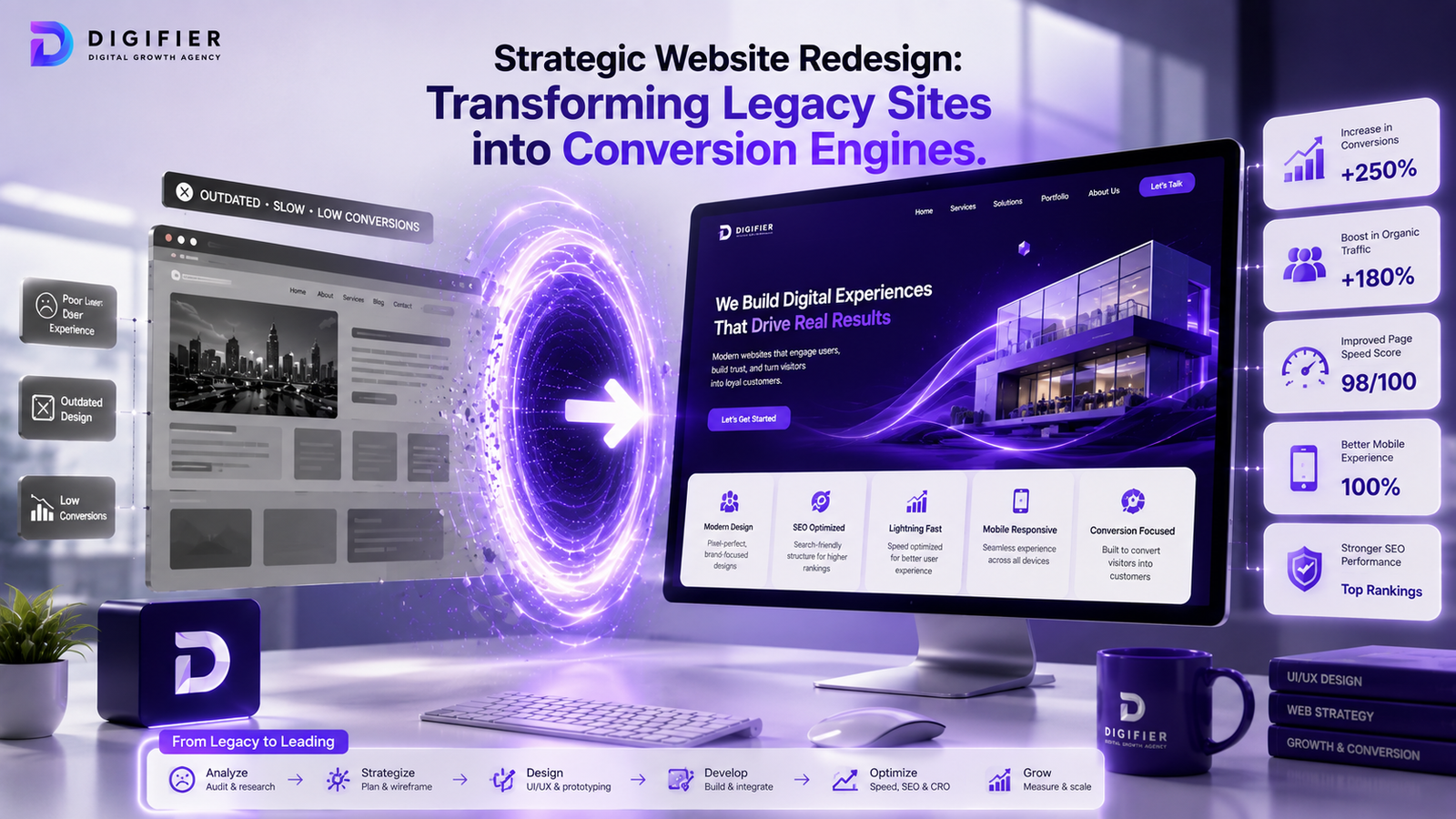
Strategic Website Redesign: Transforming Legacy Sites into Conversion Engines
For many businesses, an outdated website is more than just a visual concern—it is a functional barrier that prevents potential customers from engaging effectively. When a legacy site fails to keep pace with modern user expectations or your evolving business goals, investing in professional website redesign services becomes a critical step in reclaiming your digital footprint. A strategic overhaul moves beyond simple aesthetic updates to address core usability issues, technical debt, and misaligned conversion paths.
Transforming a legacy platform requires a clear understanding of what currently hinders your success and how a modern, high-performance site can bridge that gap. By prioritizing a data-informed approach, you can turn an underperforming asset into a consistent engine for business growth.
A professional website redesign transforms a legacy site by aligning visual structure, user experience, and technical performance with current business goals. The process involves identifying friction points in the user journey, optimizing page load times, ensuring mobile responsiveness, and creating clear pathways that encourage visitors to take meaningful actions, ultimately shifting the site from a stagnant information page to a proactive conversion engine.
Table of Contents
- Identifying the Need for a Modern Redesign
- Defining Your Conversion Objectives
- Technical Foundation and Performance
- User Experience as a Growth Driver
- Measuring Success After the Launch
Identifying the Need for a Modern Redesign
Recognizing when a website has become a liability is the first step toward recovery. Many legacy sites suffer from “design fatigue,” where the interface feels disconnected from the current brand identity. Beyond appearances, deeper issues often include broken navigation flows, poor mobile performance, and difficulty in managing content.
If your current infrastructure restricts your ability to adapt to market changes, it may be time to seek website rebuilding services. Modernizing an outdated website allows you to resolve persistent technical hurdles while creating a scalable environment for future growth.
Defining Your Conversion Objectives
A website cannot act as a conversion engine if its goals are unclear. Before beginning a redesign, you must define exactly what a “conversion” means for your specific model. Is it a completed contact form, a direct purchase, a demo request, or an email subscription?
Once these objectives are established, the architecture of the site should be built to support these specific user paths. A design that prioritizes these goals will naturally remove secondary elements that distract visitors from taking the desired action.
Technical Foundation and Performance
Technical health is the invisible backbone of any successful website. Even the most visually stunning design will fail to convert if the underlying performance is sluggish or if the site architecture creates barriers for search engines. Professional redesigns focus heavily on optimizing page load times and ensuring the site is fully compatible across all modern devices.
Digifier Web Technologies LLP emphasizes that performance and accessibility are not optional features; they are foundational to maintaining user interest and search visibility. By auditing existing technical debt, you can ensure that the new site architecture is lean, fast, and primed for long-term reliability.
User Experience as a Growth Driver
User experience (UX) design is the process of making your website intuitive for your target audience. A legacy site often suffers from “bloated” menus and confusing layouts that were added over time without a cohesive strategy. A proper redesign streamlines the user journey, ensuring that visitors can find what they need with minimal effort.
When the path to conversion is clear and frictionless, the probability of user engagement rises. Effective conversion-focused web design balances aesthetics with practical utility, ensuring that your site remains both engaging and effective at driving business outcomes.
Measuring Success After the Launch
The launch of a redesigned site is just the beginning of the conversion optimization process. To ensure the site continues to serve as an effective engine, you must establish a framework for ongoing measurement and refinement.
- Monitor key interaction points to see where users might still drop off.
- Regularly test new call-to-action placements to optimize click-through behavior.
- Review technical performance reports to catch and fix slow-loading elements before they become issues.
Conclusion
A strategic website redesign is a transformative investment that aligns your digital presence with your modern business objectives. By moving away from legacy limitations and embracing a user-centric, high-performance architecture, you create a foundation for consistent growth. Professional website redesign services provide the clarity and technical expertise needed to ensure your site is not just a digital brochure, but a highly effective conversion engine. With a focus on usability, speed, and clear conversion paths, your redesigned site will be well-equipped to meet the challenges of an evolving market and deliver value to both your business and your customers.