

Scaling Your Business Without Hiring More Staff: Choosing the Right Commercial Software Solutions
Expanding operations often creates an immediate pressure to increase headcount. Growing order volumes, rising customer inquiries, and complex administrative processes can quickly overwhelm existing teams. However, relying solely on recruitment to handle operational growth increases fixed overhead, complicates organizational structure, and often creates diminishing returns on productivity.
Modern organizations achieve sustainable operational leverage by replacing manual labor with optimized digital systems. Investing in strategic software architecture enables growing companies to automate redundant tasks, integrate fragmented data flows, and increase transaction throughput without expanding payroll. Selecting effective custom commercial software solutions allows leadership to scale output, maintain service quality, and protect operational margins.
Direct Answer: Businesses can scale without hiring additional staff by digitizing routine processes, eliminating data silos, and deploying software that handles higher operational volumes automatically. Commercial software solutions streamline workflow execution, centralize information management, and empower existing employees to manage larger workloads efficiently without increasing operational risk or overhead cost.
Table of Contents
- The Operational Bottlenecks of Headcount-Based Scaling
- How Software Systems Enable Non-Linear Growth
- Key Criteria for Evaluating Commercial Software
- Off-the-Shelf vs Custom Software Architecture
- Strategic Steps to Implement Scalable Software
- Mitigating Implementation Risks and Ensuring Adoption
The Operational Bottlenecks of Headcount-Based Scaling
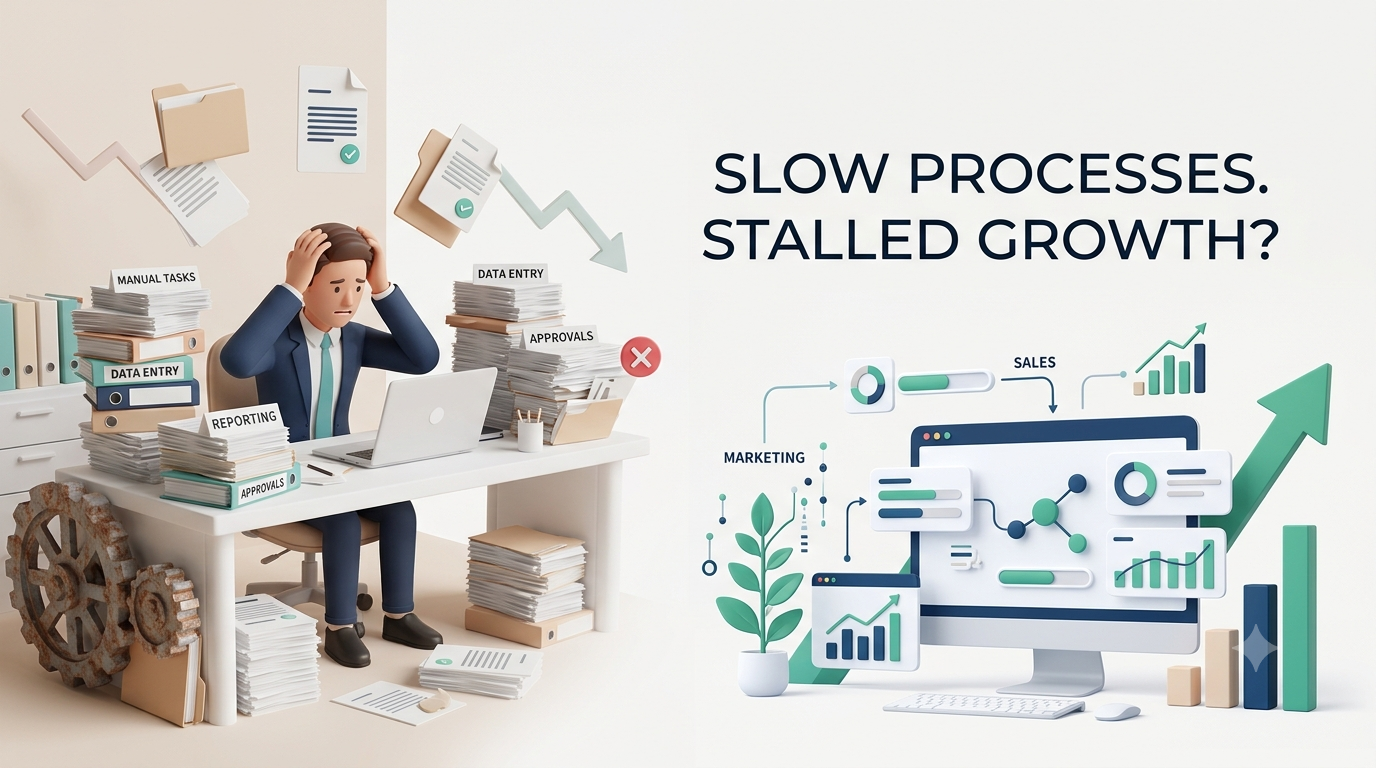
Traditional business expansion assumes that higher revenue requires proportional increases in workforce size. While adding staff increases gross capacity, it also introduces managerial friction, training requirements, and communication complexity. Over time, recurring labor costs can compress operating margins if revenue per employee plateaus.
Manual operational workflows present clear limitations during rapid expansion:
- Human Error and Inconsistency: Manual data entry across multiple spreadsheets leads to mistakes, delayed order fulfillment, and inconsistent customer experience.
- Communication Overhead: As staff size grows, internal coordination takes up an increasing portion of total working hours, slowing down key decision-making processes.
- Inflexible Cost Structures: Payroll represents a fixed long-term financial commitment that cannot easily adjust when market demand fluctuates.
- Key-Person Dependency: Standard operating procedures stored in employee memory rather than standardized digital tools leave operations vulnerable to turnover.
How Custom Commercial Software Solutions Enable Non-Linear Growth
Software systems break the linear connection between operational volume and headcount. By digitizing recurring tasks and standardizing business logic, applications handle expanded workloads with minimal marginal effort. This leverage allows companies to serve significantly more clients without linear payroll expansion.
Deploying tailored platform architecture allows businesses to transform manual sequences into automated, reliable workflows. Core operational areas benefiting from software modernization include:
Automated Workflow Orchestration
Commercial platforms automate cross-departmental handoffs. For instance, an inbound order can instantly update inventory levels, notify fulfillment teams, generate invoicing documentation, and issue tracking updates to customers without manual intervention.
Centralized Data Consolidation
Disconnected databases slow down operations and force staff to spend hours compiling reports manually. Modern software architectures integrate databases into unified dashboards, providing real-time visibility across sales, inventory, accounting, and operations.
Organizations evaluating strategic expansion often partner with technology specialists to build tailored platforms. For instance, Digifier Web Technologies LLP designs scalable system architectures aligned directly with operational growth objectives, enabling leadership to streamline workflows without accumulating unnecessary software friction.
Key Criteria for Evaluating Commercial Software
Selecting software systems requires balancing immediate capabilities with future operational requirements. Choosing rigid or poorly architecture software can create operational debt that hinders future expansion.
When evaluating potential enterprise and operational systems, decision-makers should prioritize the following core criteria:
- API Connectivity: The software must integrate cleanly with existing payment gateways, communication channels, and accounting software through robust APIs.
- System Scalability: System performance must remain stable as active database entries, concurrent users, and daily transactions increase.
- User Interface Usability: Complex interfaces increase employee onboarding time and lower daily adoption rates. Intuitive UI reduces operational resistance.
- Security and Compliance: Role-based access controls, automated data backups, and regulatory compliance features protect proprietary operational data.
Off-the-Shelf vs Custom Software Architecture
A crucial strategic decision when upgrading business technology is choosing between off-the-shelf software tools and custom-engineered systems. Both options serve specific business requirements depending on operational complexity, industry requirements, and budget constraints.
Off-the-shelf software excels at solving generalized business functions such as basic accounting or email messaging. However, as business operational volume expands, generic platforms often present integration limits, forcing staff to manually bridge gap areas across incompatible software products.
Conversely, custom software architecture eliminates operational compromises. Custom platforms are designed to map precisely to proprietary operating models, granting full control over system capabilities, user access levels, and data structures.
Strategic Steps to Implement Scalable Software
Transitioning from manual workflows to integrated digital platforms requires a methodical implementation strategy. Adopting software without structured planning can disrupt current operations and reduce employee buy-in.
- Map Internal Workflows: Identify repetitive manual tasks, data transfer points, and current execution bottlenecks across all operational units.
- Define Functional Requirements: Document essential capabilities, security criteria, necessary integrations, and performance expectations.
- Select Architectural Approach: Determine whether commercial SaaS tools, custom modules, or a hybrid infrastructure best fulfills operational requirements.
- Execute Phased Deployment: Roll out initial system modules in controlled phases to validate performance without disrupting active client fulfillment.
- Establish Training and Support: Provide staff with thorough documentation and structured workflow training to ensure seamless operational transition.
Mitigating Implementation Risks and Ensuring Adoption
Software investments fail to achieve operational leverage when systems lack user adoption or fail to reflect core operational realities. Leadership must manage digital transformation as an operational change initiative rather than a simple IT installation.
To minimize migration risks, leadership should actively involve end-user employees during early requirements gathering. Frontline staff possess direct insight into workflow friction points and operational edge cases. Involving team members early ensures built platforms streamline daily tasks effectively while accelerating overall system adoption.
Additionally, establishing measurable operational benchmarks—such as reduced order processing times, lowered error rates, or increased ticket response speeds—provides clear visibility into platform performance and return on technological investment.
Sustained Growth Through Operational Efficiency
Scaling a growing business successfully does not mandate continuous overhead expansion. By evaluating operational bottlenecks, modernizing legacy processes, and selecting tailored software architectures, organizations construct scalable foundations for expanding market share.
Adopting purposeful custom commercial software solutions transforms static operations into responsive digital ecosystems, enabling existing teams to drive business expansion efficiently.