


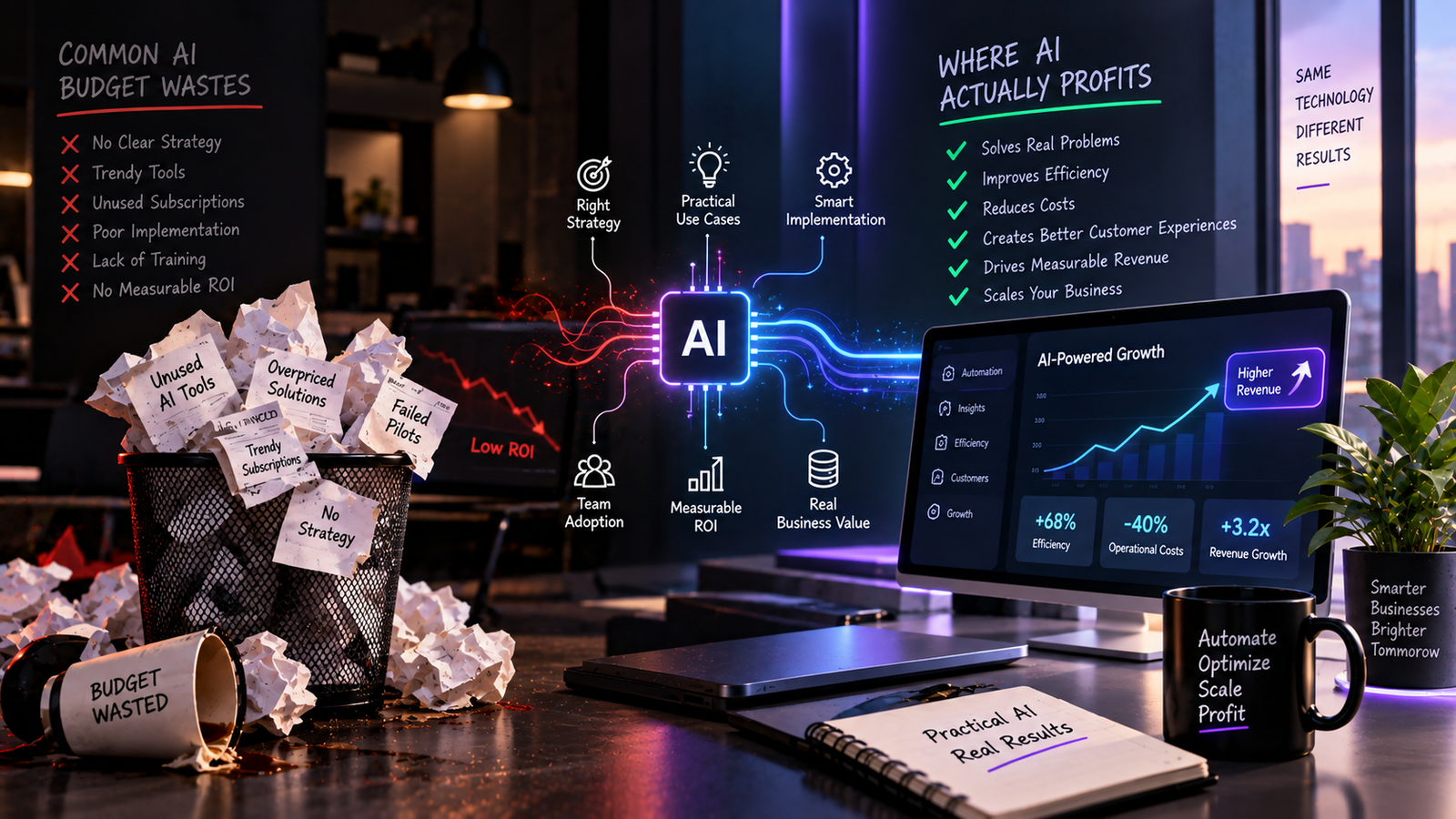
Integrating Practical AI Solutions: Where Businesses Waste Budget Versus Where They Actually Profit
Artificial intelligence has shifted rapidly from an experimental technology to an essential operational component for modern enterprises. However, despite widespread interest, many organizational investments fail to deliver measurable financial returns. The disparity between capital spent and value realized usually stems from poor scope alignment, misdirected priorities, and chasing novelty over operational efficiency. When evaluating professional AI integration services for business, decision-makers must distinguish between high-maintenance trends and sustainable, value-generating applications.
Unlocking actual profitability requires moving past flashy customer-facing novelties and focusing on internal friction points, data orchestration, and process automation. Understanding where artificial intelligence drains financial capital and where it genuinely enhances efficiency is crucial for leaders seeking sustainable growth without technical debt.
Direct Answer: Businesses waste budget on AI by building custom models from scratch, deploying gimmicky chatbots without deep workflow integration, and running unanchored pilot projects. Conversely, companies achieve profit by applying targeted AI solutions to high-volume operational bottlenecks, document processing, contextual data retrieval, and automated system synchronization that directly lowers operational costs.
Table of Contents
- The High Cost of Unfocused AI Adoption
- Where AI Budgets Disappear: Common Allocation Pitfalls
- High-ROI Applications: Where AI Yields Genuine Business Value
- Key Criteria for Evaluating AI Integration Services for Business
- Practical AI Implementation: A Side-by-Side Comparison
- Strategic Roadmap: Moving from AI Hype to Operational Value
The High Cost of Unfocused AI Adoption
The rapid emergence of generative models and intelligent automation platforms has created intense pressure on commercial leadership teams to demonstrate adoption. This urgency frequently results in reactive spending, where software is procured before clear problem statements or measurable key performance indicators are defined.
When organizations deploy technology without clear alignment between architecture, existing software infrastructure, and real human workflows, friction increases. The issue is rarely the capability of underlying algorithms; rather, it lies in the absence of business logic connecting automated outputs to day-to-day operations.
Businesses that treat artificial intelligence as a general cure-all often find themselves trapped in perpetual proof-of-concept cycles. Resources are continuously allocated toward prototype testing, yet these builds rarely reach production deployment because they lack integration with underlying enterprise resource planning or customer management systems.
Where AI Budgets Disappear: Common Allocation Pitfalls
Identifying financial waste early protects capital and ensures engineering effort remains focused on meaningful operational objectives. Several recurring patterns explain where organizational spending fails to yield returns.
1. Building Proprietary Models When Standard APIs Suffice
One of the most expensive mistakes is attempting to train specialized foundation models internally for standard tasks. Training, fine-tuning, and hosting custom large language models requires specialized hardware, specialized talent, and continuous maintenance. Unless a company owns unique proprietary data that provides a major defensive moat, leveraging established foundation models via secure API endpoints integrated into existing custom business software offers far greater financial efficiency.
2. Disconnected Customer-Facing Interfaces
Deploying front-facing conversational tools that lack backend system access often degrades user experience instead of enhancing it. Generic conversational bots that cannot access real-time inventory, order histories, or technical documentation offer negligible value and frequently require human intervention to resolve basic queries.
3. Ignoring Data Engineering Fundamentals
Automated systems depend heavily on clean, well-structured, and accessible data. Implementing sophisticated reasoning tools on top of fragmented, duplicated, or unorganized internal databases leads to inconsistent outputs and user distrust. A significant portion of wasted expenditure stems from applying intelligence tools over broken data pipelines.
- Over-engineered Prototypes: Allocating budget to hyper-complex designs before verifying basic workflow utility.
- Siloed Technology Procurement: Buying isolated software tools that cannot share context across departments.
- Lack of Continuous Evaluation: Failing to monitor ongoing inference performance, accuracy metrics, and API consumption expenses.
High-ROI Applications: Where AI Yields Genuine Business Value
Sustainable commercial return comes from targeted applications that directly minimize manual labor, eliminate operational bottlenecks, and accelerate decision-making cycles. Successful organizations focus on practical automation integrated directly into operational routines.
Internal Knowledge Retrieval (Retrieval-Augmented Generation)
Connecting foundational models securely to internal company documentation, technical manuals, compliance policies, and project archives enables employees to extract accurate operational guidance instantly. This application significantly reduces hours spent manually searching through static repositories, allowing teams to focus on revenue-generating tasks.
Document Processing and Automated Data Triage
Organizations processing high volumes of invoices, contracts, customer requests, or medical forms achieve significant leverage by implementing intelligent extraction engines. Automated parsing transforms unstructured incoming data into structured formats directly consumable by existing database architectures.
Businesses evaluating this operational transition should consider how technical strategy, system integration, and performance tracking work together. Digifier Web Technologies LLP supports business technical initiatives by building custom workflow automations designed around measurable operational goals rather than speculative technology trends.
Key Criteria for Choosing AI Integration Services for Business
Selecting the right engineering and implementation team is critical to preventing budget leakage. Selecting a partner based solely on marketing claims often leads to superficial solutions that fail under technical stress. Decision-makers should apply clear framework criteria during partner evaluation:
- Data Security and Compliance Architecture: Ensure that integrated tools handle proprietary customer and corporate data through secure, private pipelines without exposing information to public training pools.
- Deep API and Systems Compatibility: Verify that proposed automated workflows interface cleanly with current software systems, preventing fragmented data islands.
- Cost-Predictable Infrastructure Design: Structure implementation models to prevent unexpected surges in API processing usage charges as operational adoption scales.
- Human-in-the-Loop Oversight Safeguards: Incorporate systematic human verification points for sensitive or mission-critical automated decision paths.
Strategic Roadmap: Moving from AI Hype to Operational Value
Transitioning toward high-yield intelligent workflows requires a structured implementation methodology. Rather than attempting enterprise-wide overhauls simultaneously, leadership should adopt an iterative engineering strategy focused on verified operational improvements.
Begin by conducting a comprehensive audit of labor-intensive process choke points across operations. Identify tasks characterized by repetitive manual data handling, standardized document parsing, or delayed response times. These areas represent prime candidates for initial automation pilots.
Establish baseline cost metrics prior to deployment, including hours expended, error frequency, and processing duration. Once initial integration occurs, continuously measure operational output against these baseline metrics to validate clear value delivery before allocating additional capital to secondary phases.
Conclusion
Successfully integrating artificial intelligence into enterprise operations requires disciplined focus, clear strategy, and systematic execution. Organizations that burn capital typically do so by pursuing novel concepts detached from core operational processes or by over-engineering unnecessary technical infrastructure. Conversely, businesses that achieve sustainable financial returns prioritize clean data foundations, workflow integration, and targeted automation of operational bottlenecks.
By selecting experienced partners for AI integration services for business, companies can eliminate unnecessary expenditures and establish scalable software infrastructure that supports quantifiable long-term efficiency.