


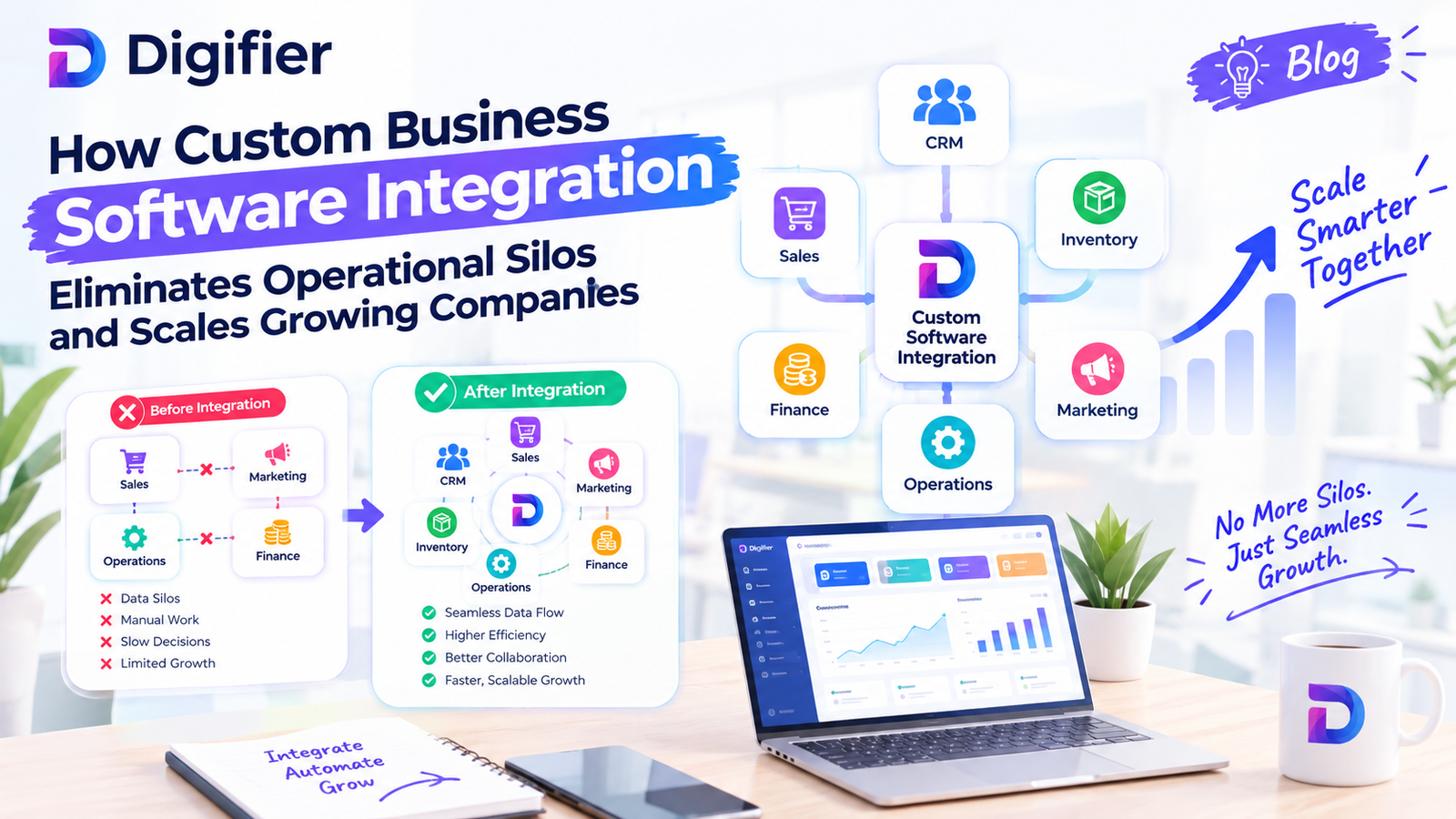
How Custom Business Software Integration Eliminates Operational Silos and Scales Growing Companies
As organizations expand, internal operations naturally grow more complex. Departments adopt separate applications to manage sales, customer service, inventory, accounting, and human resources. While individual tools solve localized problems, disconnected systems create isolated operational silos. Information becomes trapped inside specific departments, forcing teams to perform repetitive manual data entry and work with conflicting information.
To maintain sustainable growth, expanding enterprises require unified software ecosystems. Leveraging specialized custom business software development services enables organizations to bridge disparate tools, automate enterprise-wide workflows, and build an adaptable infrastructure designed to support long-term operational scaling.
Direct Answer: Custom business software integration eliminates operational silos by connecting independent departmental databases through tailored APIs and unified centralized architectures. This unified structure synchronizes operational data automatically across teams, removes redundant manual processes, improves data precision, and creates a clear, scalable foundation for organizational expansion without proportional overhead increases.
Table of Contents
- Understanding Operational Silos in Expanding Organizations
- How System Fragmentation Impairs Decision-Making and Growth
- The Role of Custom Software Development Services in Silo Elimination
- Key Architectural Components of an Integrated Enterprise Environment
- Off-the-Shelf Software vs. Integrated Custom Software Platforms
- Strategic Execution Steps for Enterprise Software Integration
- Long-Term Scalability and Value Creation
Understanding Operational Silos in Expanding Organizations
Operational silos occur when individual enterprise units work in isolation using non-interoperable software systems. In early-stage businesses, team leaders frequently purchase specialized software to manage immediate needs—such as a CRM for sales, a standalone inventory platform for operations, and specialized accounting tools for finance.
While these independent tools provide short-term relief, they prevent organizational transparency as the business scales. Data entered into one application remains inaccessible to teams using different systems, leading to delayed communication, conflicting data points, and operational friction.
- Departmental Isolation: Customer service managers lack direct visibility into real-time inventory updates or shipping pipelines.
- Data Duplication: Identical customer data is repeatedly copied and pasted across multiple platforms, introducing human error.
- Inconsistent Metrics: Leadership receives contrasting performance metrics from separate departments due to varied reporting standards.
How System Fragmentation Impairs Decision-Making and Growth
System fragmentation creates operational bottlenecks that hinder growth. Executive teams rely on real-time organizational performance metrics to guide strategic resource allocation, inventory forecasting, and capital management. When data remains trapped across isolated platforms, leadership must wait for manual consolidation before receiving meaningful business reports.
Delayed reporting limits executive agility. Companies operating on fragmented technology architectures spend excessive time resolving operational discrepancies rather than focusing on market expansion, product refinement, and customer success initiatives.
The Role of Custom Software Development Services in Silo Elimination
Eliminating operational silos requires moving away from generic, non-connected platforms. Enterprise software strategy must focus on building a unified digital ecosystem where software applications communicate continuously across secure channels.
Engaging expert custom business software development services ensures that software architecture aligns precisely with existing operating procedures. Rather than adjusting operational workflows to meet rigid software constraints, custom software architectures are engineered around the specific data structures and operational demands of the organization.
For growing enterprises, engineering partners like Digifier Web Technologies LLP design tailored integrations that connect existing legacy platforms with modern business systems, ensuring continuous, automated data exchange without business disruption.
Key Architectural Components of an Integrated Enterprise Environment
A resilient, fully integrated software ecosystem depends on several structural pillars that enable continuous communication between independent digital systems.
1. Centralized Application Programming Interfaces (APIs)
Robust, well-documented RESTful or GraphQL APIs serve as secure communication bridges between software systems. Custom API layers standardize data formats across applications, enabling instant automated updates between systems whenever transactional changes occur.
2. Automated Event-Driven Workflows
Event-driven architecture triggers downstream activities instantly. For instance, when a client signs a contract in a customer portal, automated triggers can simultaneously set up accounting profiles, allocate fulfillment resources, and inform account managers without requiring manual oversight. Where operational workflows extend to native applications, leveraging specialized app development services provides mobile workforce synchronization with backend enterprise databases.
3. Single Source of Truth (SSOT) Data Repositories
A centralized database framework aggregates key operational metrics into a single readable environment. Establishing a Single Source of Truth ensures that all departments access identical, accurate metrics, eliminating multi-departmental reporting conflicts.
Strategic Execution Steps for Enterprise Software Integration
Transitioning from a disconnected system landscape to a fully integrated ecosystem requires structured planning to prevent operational disruption.
- Operational Audit and Mapping: Map every operational system, database, and process across departments to identify data flows and manual handoff risks.
- Integration Architecture Strategy: Define integration models, specifying custom middleware requirements, API endpoints, data governance policies, and security protocols.
- Phased Development and Deployment: Execute engineering in structured phases to preserve daily operations, prioritizing connections that deliver immediate operational relief.
- System Validation and Performance Optimization: Perform thorough testing under peak transaction loads to ensure precise data transfers, security compliance, and high availability.
Long-Term Scalability and Value Creation
Software integration transforms technology overhead into a value driver. Removing operational bottlenecks empowers expanding companies to increase customer volume, add service lines, and enter new markets without linear headcount growth.
Modern custom software systems also provide an ideal foundation for advanced operational automation. Clean, integrated enterprise data streams enable organizations to deploy intelligent workflow models, automated analytics, and specialized machine-learning capabilities designed to optimize operational strategies as market demand evolves.
Conclusion
Operational silos represent a major obstacle for growing companies aiming to scale smoothly. Disconnected systems slow productivity, generate data errors, and limit leadership visibility across operational units.
By investing in professional custom business software development services, expanding enterprises build integrated digital ecosystems that eliminate process redundancy, protect data integrity, and support long-term growth. Embracing unified custom software architecture transforms operational technology into an adaptable, strategic asset built for business expansion.