

AI Agents for Business: How Smart Automation Reduces Costs and Multiplies Productivity
Running a business has never been more demanding. Costs are rising, talent is harder to retain, and customers expect faster, more personalised service. Business owners are under constant pressure to do more with less. That is exactly why AI agents for business have moved from a buzzword to a boardroom priority.
Across industries, companies are deploying AI automation tools to handle repetitive tasks, speed up decision-making, and free their teams to focus on high-value work. Whether you run a startup, an e-commerce brand, or an established enterprise, smart automation is no longer a competitive advantage — it is becoming a baseline requirement.
This article breaks down what AI agents actually are, how they reduce operational costs, and the practical steps you can take to put them to work for your business today.
What Are AI Agents? A Simple Explanation
An AI agent is a software system that can perceive its environment, make decisions, and take actions to achieve a specific goal — with minimal or no human involvement. Think of it as a digital employee that never sleeps, never makes emotional decisions, and gets better over time.
Unlike basic automation that follows rigid rules, AI agents use machine learning and natural language processing to adapt. They can read emails, analyse data, respond to customers, generate reports, and trigger actions across your existing tools and platforms.
In practical terms, a single AI agent can replace or support entire workflows — from lead qualification and invoice processing to inventory management and customer service.
How AI Agents Reduce Business Costs
One of the most compelling reasons to invest in business automation is the direct impact on your bottom line. Here is where the savings compound:
- Labour costs: Repetitive, manual tasks consume enormous amounts of staff time. AI agents automate data entry, scheduling, document processing, and routine communications, reducing headcount requirements and allowing existing staff to focus on strategic work.
- Error reduction: Human error is expensive. Whether it is a misfiled order, an inaccurate report, or a missed follow-up, mistakes cost time and money. AI automation tools execute tasks consistently, reducing costly errors.
- Faster turnaround: AI agents work in real time, 24 hours a day. Faster order processing, quicker customer responses, and instant data analysis all translate to reduced operational drag and improved cash flow.
- Scalability without overhead: As your business grows, AI agents scale with you. You do not need to hire proportionally more staff to handle increased volume — the system absorbs the load.
Businesses that actively reduce operational costs through automation often report savings of 20 to 40 percent on specific workflow categories within the first year of deployment.
How Smart Automation Improves Productivity and Efficiency
Beyond cost savings, smart automation transforms how your team operates. When routine tasks are offloaded to AI agents, your people spend more time on the work that actually moves the business forward — strategy, creativity, and relationship-building.
Consider the cumulative impact: if each team member saves just one hour per day through automation, a team of ten recovers fifty hours of productive time each week. That is fifty hours that can be redirected toward growth, innovation, or customer success.
AI agents also improve productivity by providing better data. They capture, organise, and analyse information at a scale no human team can match. Decision-makers get cleaner insights, faster, with less manual effort — enabling smarter choices at every level of the business.
Real Business Use Cases for AI Agents
Customer Support
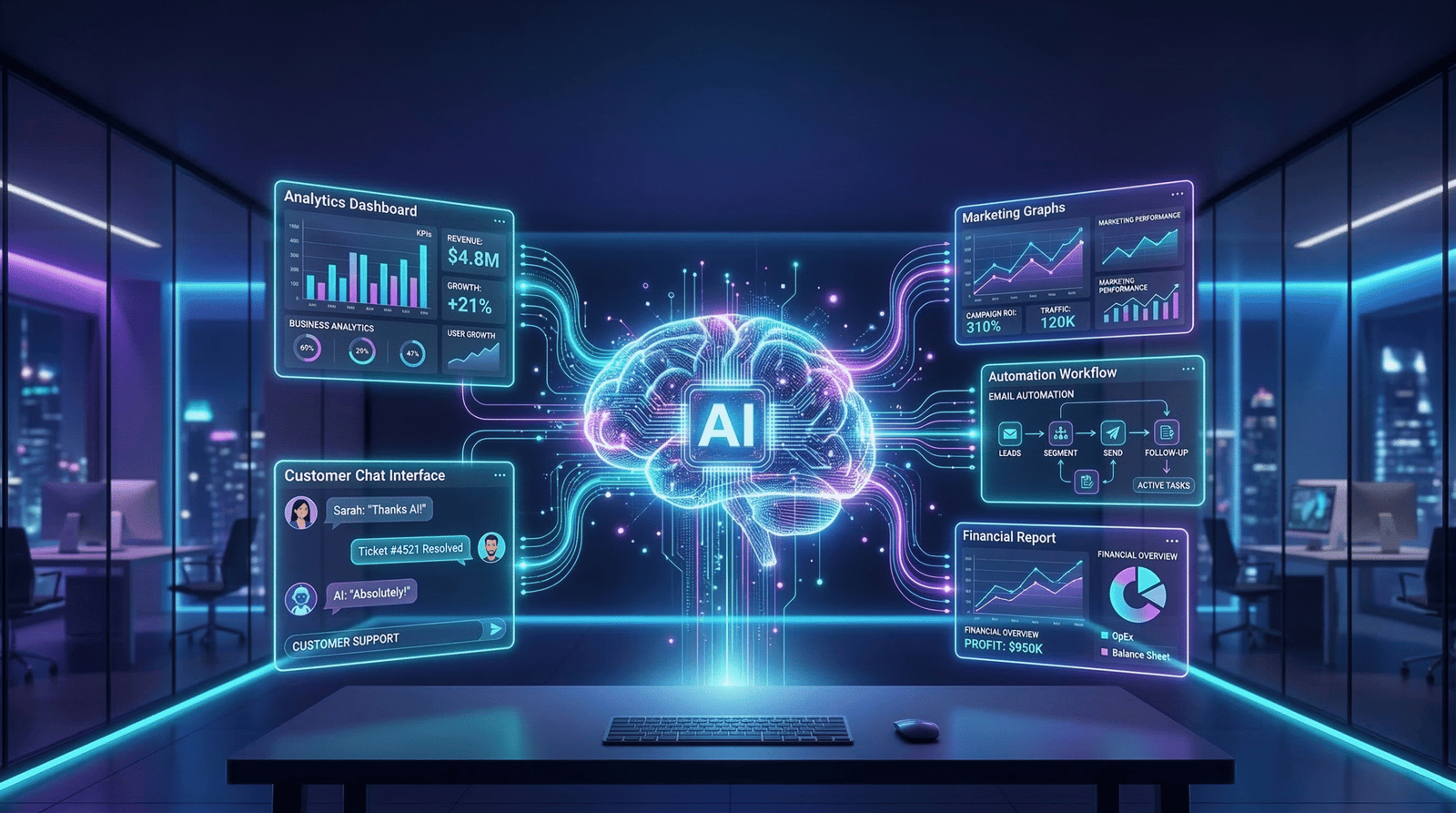
AI-powered chatbots and virtual agents handle tier-one support queries around the clock. They resolve common issues, gather information before escalating to human agents, and dramatically reduce average response times. For e-commerce brands in particular, this means fewer abandoned carts and higher customer satisfaction scores.
Marketing Automation
From email segmentation to social media scheduling and personalised campaign delivery, AI agents execute marketing workflows at scale. They analyse user behaviour, adjust messaging dynamically, and ensure the right content reaches the right audience at the right time — without manual micromanagement.
Data Analysis and Reporting
Instead of waiting for weekly reports or spending hours in spreadsheets, AI agents continuously monitor business metrics and surface insights as they emerge. Sales trends, customer behaviour, operational bottlenecks — all delivered automatically, enabling faster, evidence-based decisions.
Operations and Workflow Management
AI agents coordinate across departments — managing approvals, tracking project status, processing invoices, and flagging exceptions that require human attention. They act as an intelligent layer that keeps operations moving smoothly, even during high-volume periods.
How to Start Using AI Agents in Your Business
You do not need a large technology budget or an internal engineering team to get started. Here is a straightforward approach:
- Identify your highest-friction workflows. Where does your team spend the most time on repetitive tasks? Start there.
- Set clear objectives. Define what success looks like — whether that is reducing response time, cutting processing costs, or improving lead conversion.
- Choose the right AI automation tools. Select platforms that integrate with your existing systems and have a proven track record in your industry.
- Start small and scale. Pilot one or two automations before expanding across the business. Measure results, refine, and build from there.
- Partner with a specialist. Working with an AI automation partner accelerates deployment, reduces risk, and ensures your automations are built for long-term performance.
Conclusion: The Time to Automate Is Now
The businesses that will lead their industries over the next decade are those investing in AI agents and smart automation today. The returns are real — lower costs, higher productivity, better customer experiences, and the operational agility to grow without limits.
The question is not whether to adopt AI automation. It is how quickly you can do it effectively.
At Digifier, we help startups, e-commerce brands, and growing businesses build and deploy AI automation systems that deliver measurable results. From strategy to implementation, we are your end-to-end AI automation partner.