


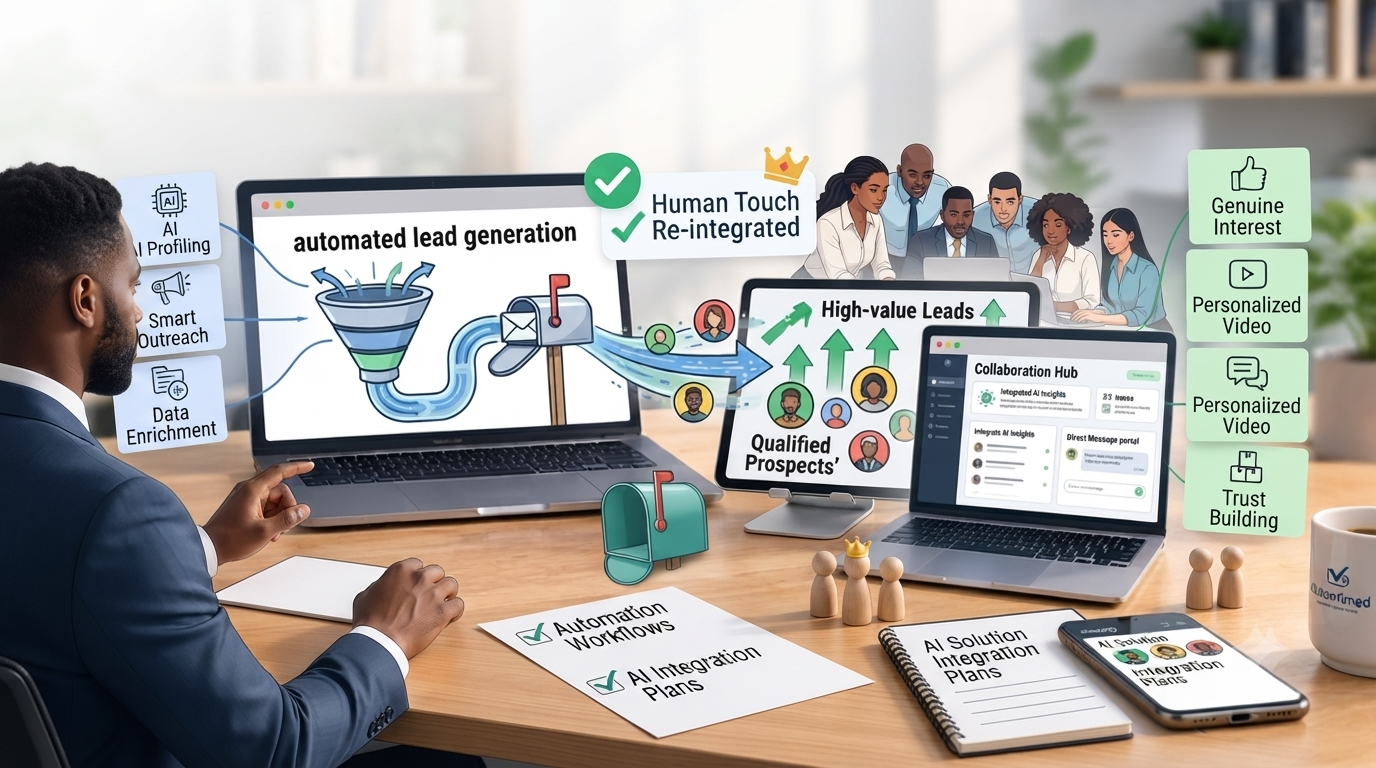
How to Automate Lead Generation with AI Without Losing the Human Touch
Deploying ai lead generation automation for businesses allows modern commercial organizations to scale outreach, qualify prospects swiftly, and eliminate repetitive pipeline tasks. However, purely mechanized workflows frequently create sterile, disconnective buyer interactions that deter potential clients. Preserving relationship value requires balancing computational scale with intentional human discretion.
Sustainable revenue growth occurs when intelligent tools handle volume-heavy research, data synthesis, and routine sorting, while professional sales teams step in for contextual dialogue, negotiation, and strategic advisory moments. Knowing exactly when algorithms should yield to human representatives is the foundation of modern digital acquisition.
To automate lead generation with artificial intelligence without losing empathy, use automated systems exclusively for data extraction, intent recognition, behavioral scoring, and preliminary filtering. Transition every prospect to personal sales engagement the moment they demonstrate nuanced objections, bespoke technical requirements, or explicit commercial intent.
Table of Contents
- The Role of Machine Intelligence in Modern Lead Acquisition
- Key Steps to Implement AI Lead Generation Automation for Businesses
- Balancing Automated Efficiency with Authentic Empathy
- Defining AI vs. Human Responsibilities in the Sales Pipeline
- Common Automation Pitfalls That Alienate High-Value Buyers
- Practical Implementation Framework for Growing Enterprises
The Role of Machine Intelligence in Modern Lead Acquisition
Traditional customer acquisition frameworks frequently require professionals to spend substantial manual labor finding contact details, verifying domain accuracy, and sorting inquiries. Automated pipelines fundamentally adjust this allocation of time. Machine intelligence reviews broad firmographic datasets, identifies accounts demonstrating active market demand, and correlates engagement signals across multiple communication channels.
When organizations deploy tailored AI solutions for businesses, acquisition models evolve from static contact forms toward continuous, responsive engagement flows. The machine acts as an intelligent discovery layer, highlighting prospective accounts whose operational challenges align directly with organizational solutions.
Key Steps to Implement AI Lead Generation Automation for Businesses
Successful implementation requires systematic architecture rather than disparate tool installation. Organizations that achieve reliable acquisition follow a sequence that integrates algorithmic speed with clear escalation boundaries.
- Establish Precise Firmographic Parameters: Train automated agents on detailed buyer criteria, including operational size, technology stacks, target geographies, and commercial models, to ensure lead scoring models reject poor fits immediately.
- Deploy Conversational Discovery Interfaces: Implement intelligent web assistants capable of answering preliminary questions, assessing functional requirements, and capturing intent without relying on repetitive questionnaires.
- Automate Contextual Data Enrichment: Ensure back-end software enriches incoming records with public business data, active hiring signals, and operational indicators before notifying commercial representatives.
- Implement Dynamic Routing Triggers: Establish workflow conditions that immediately assign high-priority leads to domain specialists based on buyer intent depth, enterprise tier, or specific industry vertical.
- Maintain Ongoing Model Calibration: Audit automated interactions periodically to refine response prompts, adjust qualification scoring, and remove awkward linguistic phrasing.
Balancing Automated Efficiency with Authentic Empathy
The human touch is not defined by manual administrative typing; it is defined by situational understanding, emotional intelligence, and contextual problem-solving. Mechanization fails when business buyers sense they are conversing with an unmonitored algorithm that fails to address their explicit operational reality.
To protect authentic relationship dynamics, automation should serve as a strategic preparation tool for your human workforce. Algorithms can analyze prospect profiles, synthesize corporate updates, and generate tailored conversation briefs. When a representative enters the dialogue, they arrive armed with meaningful perspective rather than generic sales questions.
Businesses evaluating these automated acquisition systems often collaborate with technology partners to build tailored workflows. As an experienced technical consultancy, Digifier Web Technologies LLP designs cohesive operational architectures that help commercial enterprises integrate algorithmic processing while maintaining authentic client advisory relationships.
Defining AI vs. Human Responsibilities in the Sales Pipeline
Preventing disjointed buyer journeys requires a strict division of responsibilities throughout the sales cycle. The table below outlines how automated systems and human professionals collaborate effectively across pipeline phases.
Common Automation Pitfalls That Alienate High-Value Buyers
When automation initiatives backfire, it is rarely due to algorithmic incompetence. More often, systems fail because businesses deploy technology without adequate safeguards, contextual empathy, or escalation boundaries.
- Overusing Generic Generated Messaging: Mass-distributing synthetic outreach that lacks tangible industry knowledge signals indifference, eroding institutional credibility.
- Neglecting Rapid Human Hand-offs: Forcing an executive prospect to continue messaging a chatbot when they have already requested a human consultation creates friction and brand fatigue.
- Ignoring Fragmented Data Systems: Allowing conversational tools to operate in isolation from your primary business management software leads to repetitive prospect interactions and lost context.
- Treating Every Lead Identically: High-value strategic enterprise accounts require immediate personal attention, whereas low-touch inquiries can navigate automated self-service tracks much longer.
Practical Implementation Framework for Growing Enterprises
To adopt automated lead acquisition safely, establish clear protocol governance before expanding technological toolsets. Start by identifying the most tedious manual bottlenecks inside your current sales organization. Routine tasks—such as updating customer relationship systems, identifying decision-makers, and confirming exploratory call times—should be automated first.
Simultaneously, build structured review checkpoints. Sales managers should audit automated message transcripts weekly to identify awkward phrasing or misplaced responses. When automation simplifies logistics while human teams drive meaningful discussions, lead generation transforms from an intrusive volume game into a scalable client relationship engine.
Conclusion
Adopting ai lead generation automation for businesses does not require trading away interpersonal warmth for operational velocity. The most successful organizations treat algorithmic tools as workflow accelerators that relieve sales professionals of administrative burdens, empowering them to focus entirely on consultative problem-solving.
By delegating high-volume sorting to machine intelligence and reserving complex diagnostic conversations for experienced team members, your business establishes a balanced customer acquisition engine that scales reliably while cultivating genuine buyer trust.
Relevant Hashtags
#AILeadGeneration #LeadAutomation #AISolutions #B2BLeadGeneration #IntelligentAutomation