


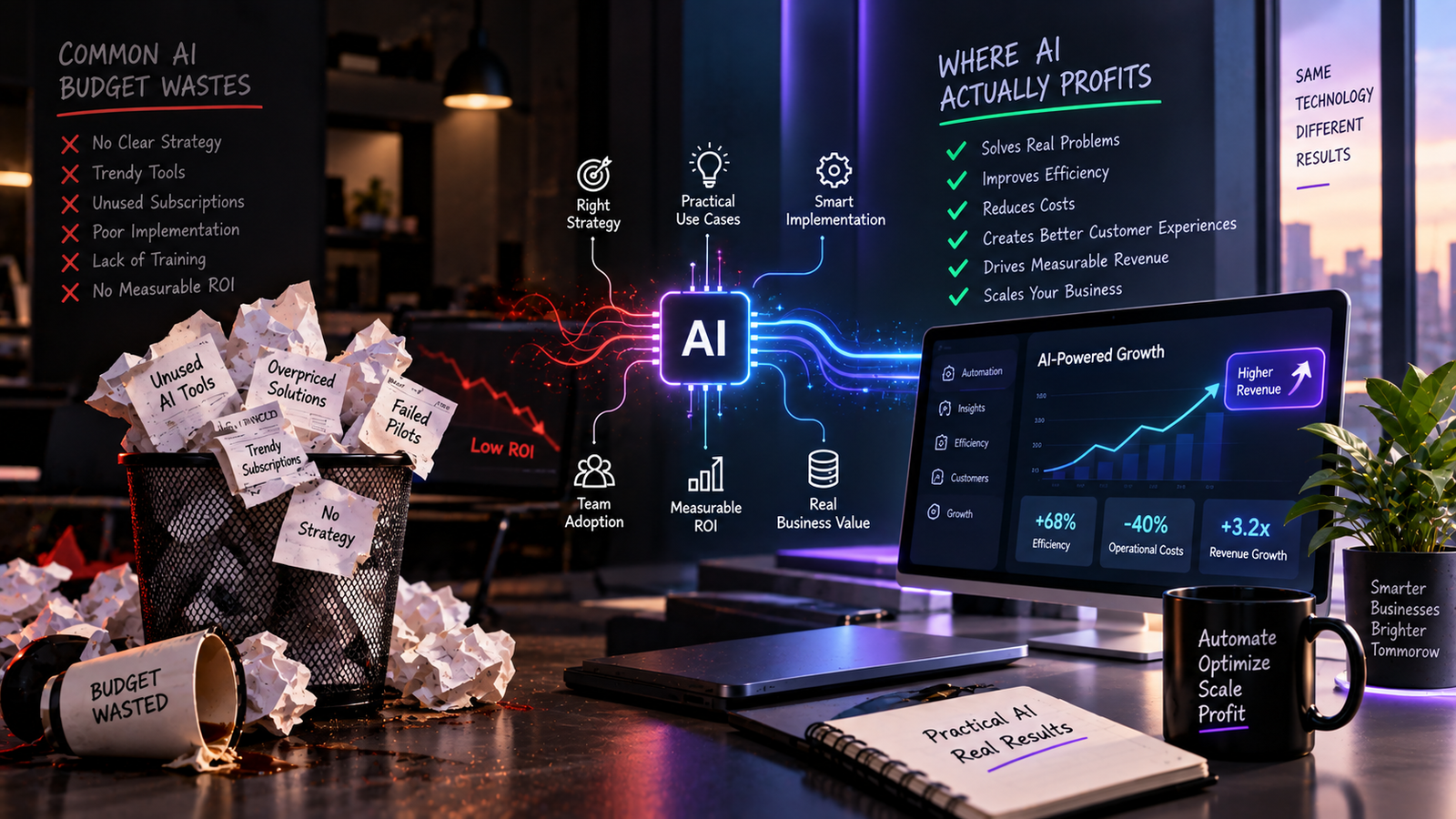
Integrating Practical AI Solutions: Where Businesses Waste Budget Versus Where They Actually Profit
Artificial intelligence has quickly transitioned from an emerging technology into a core component of modern business strategy. However, the rapid pace of adoption has created a stark divide between organizations that achieve measurable operational returns and those that incur significant financial waste. Many leadership teams deploy technology simply to keep pace with industry trends, only to discover that unguided technology investments consume substantial capital without delivering proportional improvements in efficiency or revenue.
Achieving sustainable business transformation requires shifting focus from novelty to execution. Companies that successfully capture real business value do so by targeted integration into existing operational bottlenecks, operational workflows, and decision-making processes. Evaluating professional AI integration services for business allows organizations to distinguish between speculative experimentation and high-impact deployment, ensuring that resources are allocated strictly where technological intervention generates clear financial performance.
Direct Answer: Businesses waste budget on artificial intelligence by pursuing custom-built foundational models, adopting toolsets without clear workflow integration, and automating fragmented or flawed processes. Conversely, businesses profit by deploying practical solutions into high-volume, predictable administrative workflows, customer support routing, document processing, and data-driven operational decision-making where time savings and error reduction translate directly into net bottom-line gains.
Table of Contents
- The Financial Traps of Misaligned Technology Adoption
- Where Capital is Wasted in Modern Operations
- High-ROI Frameworks: Where Practical Solutions Deliver Value
- Evaluating Infrastructure Readiness Before Implementation
- Strategic Comparison: Speculative Spending vs. Profitable Integration
- Structuring a Phased Implementation Roadmap
- Summary and Operational Outlook
The Financial Traps of Misaligned Technology Adoption
The influx of advanced software capabilities has led many executive teams to assume that adopting intelligent algorithms automatically produces competitive advantages. In practice, technology alone does not fix structural operational inefficiencies. Investing heavily in digital systems without first standardizing operational processes frequently leads to amplified confusion rather than streamlined execution.
Budget waste primarily stems from treating software implementation as a status metric rather than an engineering discipline. Organizations often acquire multiple single-purpose tools that operate in isolation, creating fragmented data silos that require ongoing manual intervention to maintain. Without clear success criteria and measurable key performance indicators, organizations struggle to track whether these tools genuinely improve productivity or simply add subscription overhead.
Where Capital is Wasted in Modern Operations
Identifying financial leaks is the essential first step toward building an effective integration blueprint. Financial resources are often depleted in specific, predictable areas when decision-makers fail to assess technical requirements accurately:
- Over-Engineering Custom Models: Developing proprietary algorithms from scratch when existing, proven models can be configured through standardized APIs introduces massive development, training, and maintenance expenses without delivering superior operational output.
- SaaS Tool Overproliferation: Licensing disconnected third-party tools for individual team members leads to bloated monthly expenses, security vulnerabilities, and redundant features that overlap with core enterprise applications.
- Automating Inefficient Workflows: Applying automated processing to broken or non-standardized internal procedures only accelerates the generation of errors, requiring administrative oversight to correct systematically generated mistakes.
- Ignoring Change Management: Deploying technical systems without structured training leads to minimal employee adoption, forcing team members to bypass automated platforms in favor of legacy manual routines.
Businesses evaluating these challenges must ensure their underlying systems are architected correctly before expanding technical commitments. Companies seeking to streamline backend processes often combine automated logic with tailored systems via commercial software solutions, ensuring that new capabilities link smoothly into existing operational databases.
High-ROI Frameworks: Where Practical Solutions Deliver Value
Sustainable profitability relies on targeted implementation that removes human intervention from repetitive task sequences while enhancing decision accuracy. Value is generated when technical solutions handle high-volume routine tasks, enabling human personnel to focus on high-value operational priorities.
1. Intelligent Document Processing and Extraction
Manual processing of invoices, contracts, customer forms, and compliance documents consumes thousands of labor hours. Utilizing automated extraction mechanisms allows companies to parse structured and unstructured text instantly, validate data against internal record systems, and route entries with high precision.
2. Predictive Operations and Inventory Management
In sectors such as logistics, retail, and manufacturing, operational profit depends heavily on inventory optimization and resource allocation. Algorithmic forecasting models analyze historical sales patterns, seasonal variance, and market demand signals to maintain lean stock levels, preventing overstock capital lockup and stockout revenue losses.
3. Targeted Customer Communication and Triage
Deploying conversational agents for basic tier-one support queries delivers dual benefits: it lowers response turnaround times for customers while reducing ticket burdens on support specialists. Integrating intelligent routing ensures complex requests reach qualified personnel along with full customer history and interaction context.
Evaluating Infrastructure Readiness Before Implementation
Technical platforms are entirely reliant on the quality of data that feeds them. Deploying sophisticated algorithms on top of disorganized, unstandardized, or inaccessible enterprise data inevitably produces unreliable outputs, leading to poor decision-making and project failure.
Before committing capital to software expansion, organizations must establish clean data pipelines, audit internal record accuracy, and enforce centralized access controls. Working with specialized advisory partners such as Digifier Web Technologies LLP helps leadership teams evaluate operational architecture, establish technical feasibility, and design implementation strategies that balance long-term flexibility with near-term return on investment.
Structuring a Phased Implementation Roadmap
To minimize initial risk and secure consistent leadership buy-in, operational leaders should implement technological updates through a structured, phased methodology:
- Process Audit and Bottleneck Identification: Map existing manual operational workflows to document labor hours, error frequencies, and execution delays. Select high-frequency, rule-based processes as prime candidates for automation.
- Proof-of-Concept Validation: Build isolated test deployments to evaluate technical accuracy, speed, and integration readiness without altering broader company operations.
- Data Integration and Security Alignment: Connect proven models to internal databases, applying granular permissions, encryption standards, and automated audit logging.
- Team Onboarding and Continuous Refinement: Provide specialized training for team members, establishing clear feedback channels to continuously tune algorithms based on practical performance.
By executing through defined milestones, management retains complete visibility over expenditure while building sustainable infrastructure that can be safely scaled across additional business units over time.
Summary and Operational Outlook
Determining where artificial intelligence generates genuine value comes down to standard financial discipline. Success requires bypassing market hype and directing capital strictly toward well-defined operational challenges. When deployed strategically into document processing, demand prediction, and customer workflow routing, intelligent technical solutions generate measurable efficiency gains that flow directly to the net bottom line.
Selecting professional AI integration services for business enables executive teams to avoid costly trial-and-error spending, establishing robust digital infrastructure designed to produce sustainable competitive advantages and long-term organizational value.