

High App Uninstall Rates? How Custom Mobile App Development Fixes UX Flaws and Retains Active Users
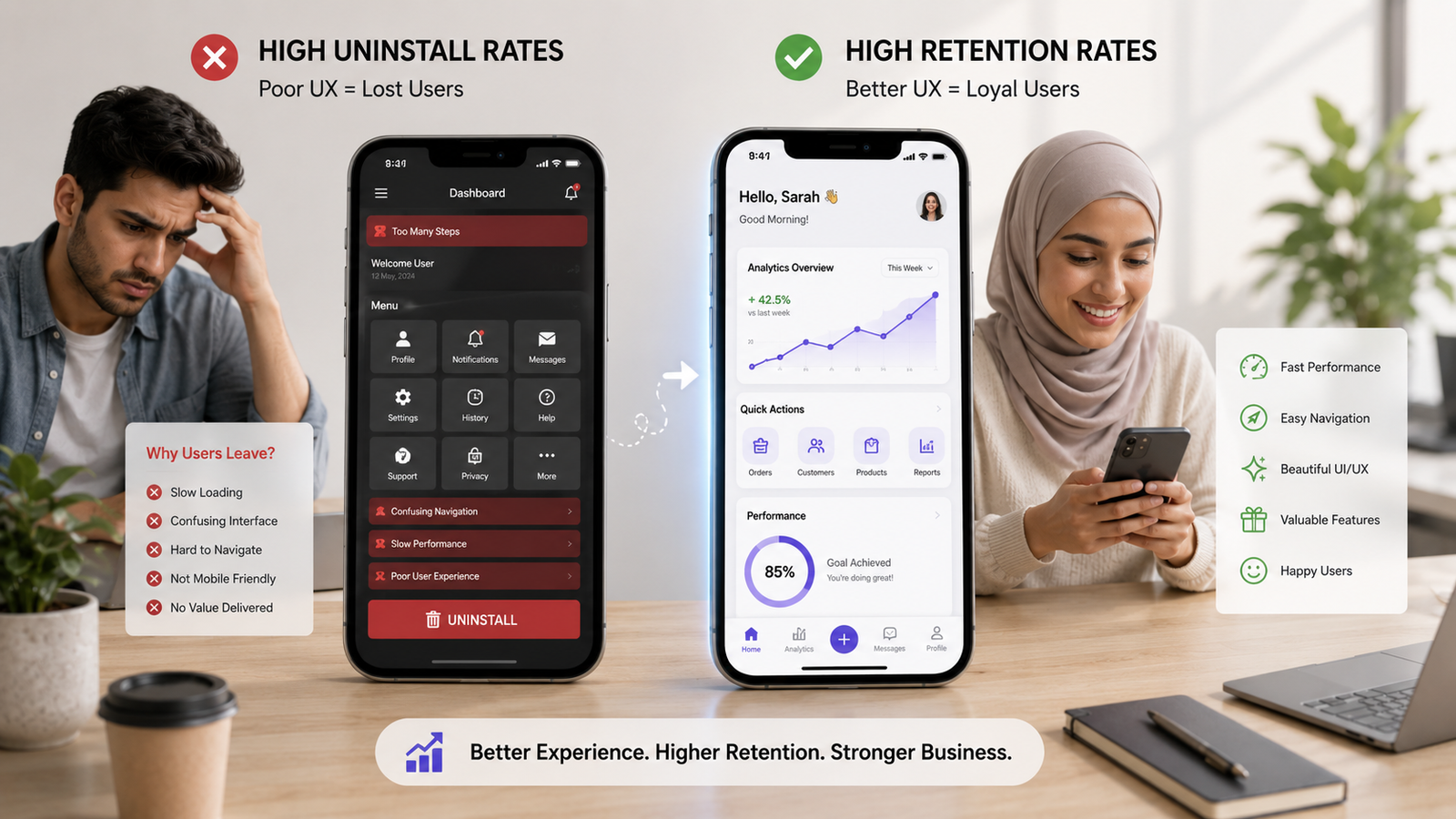
Acquiring new app users requires significant time and strategic investment, yet retaining them remains one of the most formidable challenges for modern digital businesses. When users frequently download an application only to remove it from their devices within days—or even minutes—the underlying cause rarely stems from a lack of interest in the product itself. In most cases, rapid uninstalls are driven by frustrating user experience (UX) flaws, intrusive onboarding processes, sluggish performance, or rigid navigational structures that fail to meet user expectations.
Addressing these retention bottlenecks requires more than surface-level visual updates. Partnering with a specialized mobile app development agency allows businesses to replace rigid, template-based constraints with tailored mobile architectures engineered around real human behavior. Custom mobile app development diagnoses root usability failures, optimizes task workflows, and creates seamless, performance-oriented experiences that turn casual downloaders into loyal active users.
Direct Answer: Custom mobile app development reduces high uninstall rates by eliminating specific UX flaws—such as cumbersome onboarding, slow loading times, unintuitive navigation, and excessive permission requests. Unlike rigid off-the-shelf templates, tailored app architectures align interface design and background performance directly with user expectations, delivering fast, predictable, and engaging mobile experiences that build long-term retention.
Table of Contents
- Understanding the Core Reasons Behind High App Uninstall Rates
- How Custom Mobile App Development Eliminates Usability Bottlenecks
- Comparing Template Solutions vs. Custom App Architecture
- Essential UX Enhancements That Drive Long-Term User Retention
- Strategic Steps to Audit and Fix an Existing Mobile App
- Selecting the Right Mobile App Development Agency
Understanding the Core Reasons Behind High App Uninstall Rates
High uninstall rates are rarely accidental. Mobile users possess high standards for speed, simplicity, and immediate value. When an application fails to deliver on these fundamental points, users abandon it in favor of smoother alternatives. Identifying the precise friction points within your application is the necessary first step toward sustainable active user retention.
The primary UX flaws that trigger app deletion usually fall into several distinct categories:
- Complicated Onboarding Sequences: Forcing users through multi-screen tutorials, mandatory account creation, or exhaustive personal profile forms before showing core app value leads to rapid abandonment.
- Performance Lag and Unresponsiveness: Slow screen transitions, delayed tap feedback, and frequent application crashes immediately damage trust and signal poor software quality.
- Cluttered Visual Hierarchy and Navigation: Hidden navigation menus, non-standard icon usages, and overcrowded screen layouts force users to exert excessive cognitive effort just to complete basic actions.
- Intrusive Permission Requests and Notifications: Demanding access to device contacts, location data, or camera functions immediately upon launching the app creates hesitation and user annoyance.
- Unoptimized Battery and Storage Footprints: Apps that consume excessive background memory, drain device battery quickly, or store oversized temporary cache files are prime candidates for removal during storage cleanup.
How Custom Mobile App Development Eliminates Usability Bottlenecks
Generic app builders and off-the-shelf framework templates often come bundled with unnecessary code overhead, rigid UI constraints, and standardized user flows that cannot adapt to nuanced business requirements. When retention drops, attempting to patch a rigid template often creates new performance regressions elsewhere in the app.
Custom mobile app development resolves these limitations by re-engineering the application from the ground up around user-centric design principles and lean technology stacks. Rather than forcing your core audience into predetermined templates, tailored application engineering builds bespoke user journeys optimized for intuitive interaction, immediate value delivery, and seamless native performance on iOS and Android platforms.
When organizations re-evaluate their software architecture, teams like Digifier Web Technologies LLP assist in auditing existing mobile assets, identifying hidden UX technical debt, and building lightweight, scalable native or cross-platform applications designed to support measurable retention targets.
Comparing Template Solutions vs. Custom App Architecture
To understand why generic mobile products experience higher churn rates, it is helpful to compare how generic pre-built app templates measure up against tailored custom development in key retention-critical areas.
Essential UX Enhancements That Drive Long-Term User Retention
Transforming an app with high uninstall rates into a highly retained product requires focused implementation of proven UX patterns. By addressing touchpoints where users typically experience confusion or delay, custom mobile software engineering creates a frictionless environment that encourages daily engagement.
1. Streamlining the Time-to-Value (TTV)
The moment a user opens an application, a countdown begins. The faster they experience the primary benefit of the app—whether that is viewing products, configuring a tool, or accessing content—the more likely they are to keep the app installed. Custom engineering allows for delayed account creation, guest access modes, and single-tap social sign-ons that allow users to explore value before committing personal data.
2. Contextual Permission Request Strategy
Requesting push notification privileges, camera access, or location tracking immediately upon initial launch creates distrust. A refined UX strategy introduces contextual permission prompts—asking for camera access only when the user explicitly taps to scan a document or take a photo. Explaining why a feature requires permission beforehand significantly increases user compliance and comfort.
3. Micro-Interactions and Visual Feedback
Unresponsive user interfaces make an app feel sluggish or broken. Custom mobile application engineering integrates subtle micro-interactions—such as smooth button animation states, dynamic skeleton loading screens, and haptic feedback—that signal to the user that their actions have been received and processed instantly.
4. Personalization and Adaptive Workflows
Modern consumers expect applications to adapt to their preferences over time. Custom development facilitates smart algorithms and localized state management that display recently viewed items, save ongoing progress automatically, and recommend relevant features based on individual user activity patterns.
Strategic Steps to Audit and Fix an Existing Mobile App
If your application currently suffers from declining retention metrics, executing a structured remediation plan is far more effective than making guesswork changes. A systematic UX overhaul follows a disciplined engineering progression:
- Analyze Funnel Drop-off Points: Utilize mobile product analytics to map the precise screens where users drop off during onboarding or routine task completion.
- Conduct Technical Code and UX Audits: Evaluate backend API latency, memory footprint, and UI rendering performance across diverse mobile hardware models.
- Redesign Interface Journeys: Strip away redundant steps, simplify visual clutter, and establish a clear information hierarchy prioritizing frequent tasks.
- Refactor Native Performance: Re-engineer heavy code modules, optimize asset sizing, and introduce intelligent caching mechanisms to ensure quick screen loads under variable network conditions.
- Iterate via User Testing: Deploy prototype updates to real test cohorts to validate retention improvements prior to full production releases.
Selecting the Right Mobile App Development Agency
Selecting a partner to resolve critical software usability problems requires looking beyond basic coding skills. Solving complex user churn challenges demands a strategic partner capable of blending product psychology, intuitive UI design, and high-performance engineering.
When evaluating a specialized mobile app development agency, business leaders should ensure the engineering team prioritizes human-centered design frameworks, maintains robust mobile quality assurance processes, and demonstrates clear focus on long-term product maintenance and analytics integration.
Conclusion
High app uninstall rates are a direct symptom of unaddressed UX flaws, performance bottlenecks, and misaligned user expectations. Continuing to drive marketing traffic to a leaky application creates unnecessary acquisition costs without delivering sustainable business growth. By investing in custom mobile app development, organizations can rebuild core screen flows, optimize technical execution, and establish intuitive digital experiences that retain active users month after month.