

Why Your Custom Mobile App Idea is Failing to Retain Users: Fixing Critical UX and Performance Bottlenecks
Launching a digital product involves significant strategic planning, design investments, and engineering effort. However, many businesses discover that while initial download numbers look promising, user engagement drops steeply within days or weeks of installation. When end users abandon an application shortly after installation, the core problem rarely stems from the original product vision. Instead, high churn rates usually point directly to underlying user experience friction, unintuitive visual hierarchies, or underlying engineering inefficiencies.
Partnering with an experienced custom mobile app development agency helps organizations identify whether retention failures stem from front-end user experience flaws or back-end execution gaps. Mobile users operate in fast-paced environments with high expectations for responsiveness, clarity, and security. Understanding how user experience design and software architecture intersect is essential for transforming an initial product idea into an indispensable everyday tool.
Direct Answer: Custom mobile apps fail to retain users primarily due to onboarding friction, counter-intuitive navigation, sluggish load times, unoptimized background network requests, and frequent application freezes. Resolving these retention bottlenecks requires systematic user journey mapping, front-end visual refactoring, database query optimization, efficient state management, and modern native or cross-platform architectural standards.
Table of Contents
- What Causes High User Churn in Custom Mobile Applications?
- Critical User Experience Bottlenecks That Drive Users Away
- Technical and Performance Bottlenecks Degrading App Experience
- How a Custom Mobile App Development Agency Fixes Retention Issues
- Comparing Key Mobile Bottlenecks and Strategic Engineering Fixes
- A Practical Framework for Auditing and Modernizing Your App
What Causes High User Churn in Custom Mobile Applications?
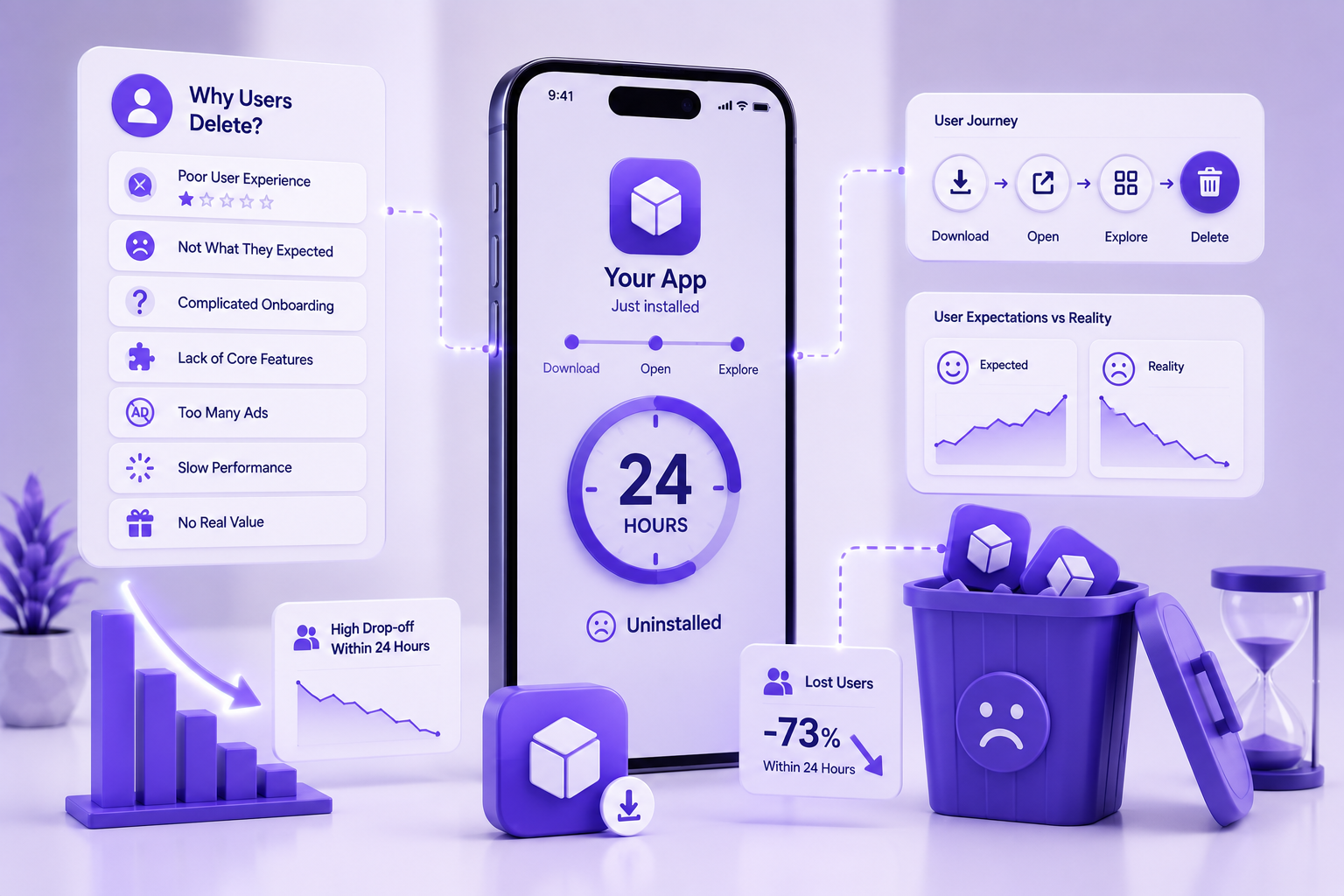
User retention is the ultimate measure of a custom application’s health and utility. When users repeatedly return to an application, it indicates that the platform consistently delivers immediate value with minimal effort. Conversely, rapid drop-off after first-time installation demonstrates a disconnect between what the user expected and what the mobile application physically delivers.
Mobile applications operate in an environment characterized by limited screen real estate, varying network bandwidth, and relentless competition for user attention. Small usability flaws or subtle performance delays compound quickly, turning brief user tasks into frustrating experiences. To fix retention issues, organizations must look beyond high-level marketing concepts and evaluate the actual operational touchpoints inside the software build.
Critical User Experience Bottlenecks That Drive Users Away
User experience design governs how effortless or taxing it feels to interact with an application interface. When front-end workflows contain structural roadblocks, users naturally seek alternatives. The most prevalent user experience bottlenecks include:
- Overwhelming Onboarding Sequences: Requiring lengthy account forms, forcing mandatory profile creation before allowing product exploration, or asking for intrusive permissions too early destroys initial user interest.
- Confusing Navigation Hierarchies: Obscuring primary core features inside complex, nested menus or failing to maintain consistent navigation anchors across screens creates mental fatigue.
- Lack of Immediate Visual Feedback: Failing to display Skeleton loaders, loading indicators, or contextual confirmation states leaves users uncertain whether an action was successfully registered.
- Inconsistent Layout Standards: Inconsistent spacing, unoptimized touch targets, and poor text contrast break usability rules that modern mobile users subconsciously expect, drawing design parallels with poor web execution similar to unoptimized responsive website design interfaces.
Addressing these design vulnerabilities requires stepping away from internal corporate assumptions and observing real users interacting with the platform. Every touch target, animation transition, and input field must be evaluated for simplicity and speed.
Technical and Performance Bottlenecks Degrading App Experience
Even the most visually stunning user interface cannot retain users if the underlying software architecture is slow, unstable, or resource-heavy. Technical bottlenecks directly impact battery consumption, device memory, and screen responsiveness, rapidly frustrating even patient users.
Unoptimized API Payloads and Network Overhead
Applications that request massive JSON payloads, perform unnecessary background sync calls, or fail to compress server responses cause extended loading spinners and drain user cellular data. Mobile network environments fluctuate constantly; software must be engineered to handle intermittent connectivity gracefully through smart client-side caching and paginated API endpoints.
Inefficient Local State Management and Memory Leaks
Poorly managed application state causes interface stuttering, frame drops, and background crashes. Unhandled objects in memory or continuous background thread polling force mobile operating systems to terminate the app unexpectedly, leading directly to negative app store reviews and permanent uninstalls.
How a Custom Mobile App Development Agency Fixes Retention Issues
Solving severe retention problems requires an integrated strategy that connects front-end product design directly to backend system engineering. Working with a dedicated specialized team allows businesses to conduct systematic diagnostic audits across both visual workflows and core application code.
At Digifier Web Technologies LLP, digital product teams approach mobile retention by analyzing user journeys, profiling runtime software performance, and eliminating operational friction points. By aligning intuitive user interface design with robust, scalable backend architecture, applications maintain high speed and reliability across diverse mobile hardware environments.
- Comprehensive UX Audits: Mapping exact drop-off points using behavioral telemetry, simplifying registration paths, and establishing clear task pathways.
- Code and Architecture Profiling: Identifying memory leaks, refactoring inefficient database queries, and reducing bundle sizes to minimize initial application cold-start delays.
- Performance Optimization & Caching: Implementing offline-first caching layers, optimistic UI rendering updates, and smart lazy loading for media assets.
Comparing Key Mobile Bottlenecks and Strategic Engineering Fixes
Understanding the direct link between platform flaws, user behavior, and engineering fixes helps product decision-makers prioritize developmental resources effectively.
A Practical Framework for Auditing and Modernizing Your App
Businesses seeking to rebuild retention metrics must implement a structured modernization process rather than guessing what needs improvement. A disciplined optimization lifecycle includes four distinct phases:
- Telemetry and Data Analysis: Integrate analytics tools to track user retention cohorts, pinpointing the exact screen or step where users abandon the app.
- Performance Profiling: Utilize native development tools to measure CPU cycles, network round-trip latencies, frame rendering consistency, and RAM usage under real-world network constraints.
- Iterative Interface Refactoring: Simplify primary conversion paths, streamline registration inputs, and introduce clear contextual notifications.
- Targeted Regression Testing: Test updated mobile builds across diverse device hardware models and OS software versions prior to rolling out app store updates.
Taking a methodical software approach converts churned users into active brand advocates while safeguarding your long-term software investment.
Conclusion
High user drop-off is rarely an unsolvable problem, but it requires addressing the root causes behind poor product engagement. From complex onboarding flows to hidden network latency and background memory leaks, fixing user retention requires a holistic approach that connects design aesthetics with clean engineering execution.
By systematically identifying friction points, auditing application architecture, and continuously refining visual interactions, businesses can turn underperforming platforms into engaging digital experiences. Partnering with a skilled custom mobile app development agency equips organizations with the technical expertise, UX methodology, and execution framework needed to maximize long-term retention and scale effectively.